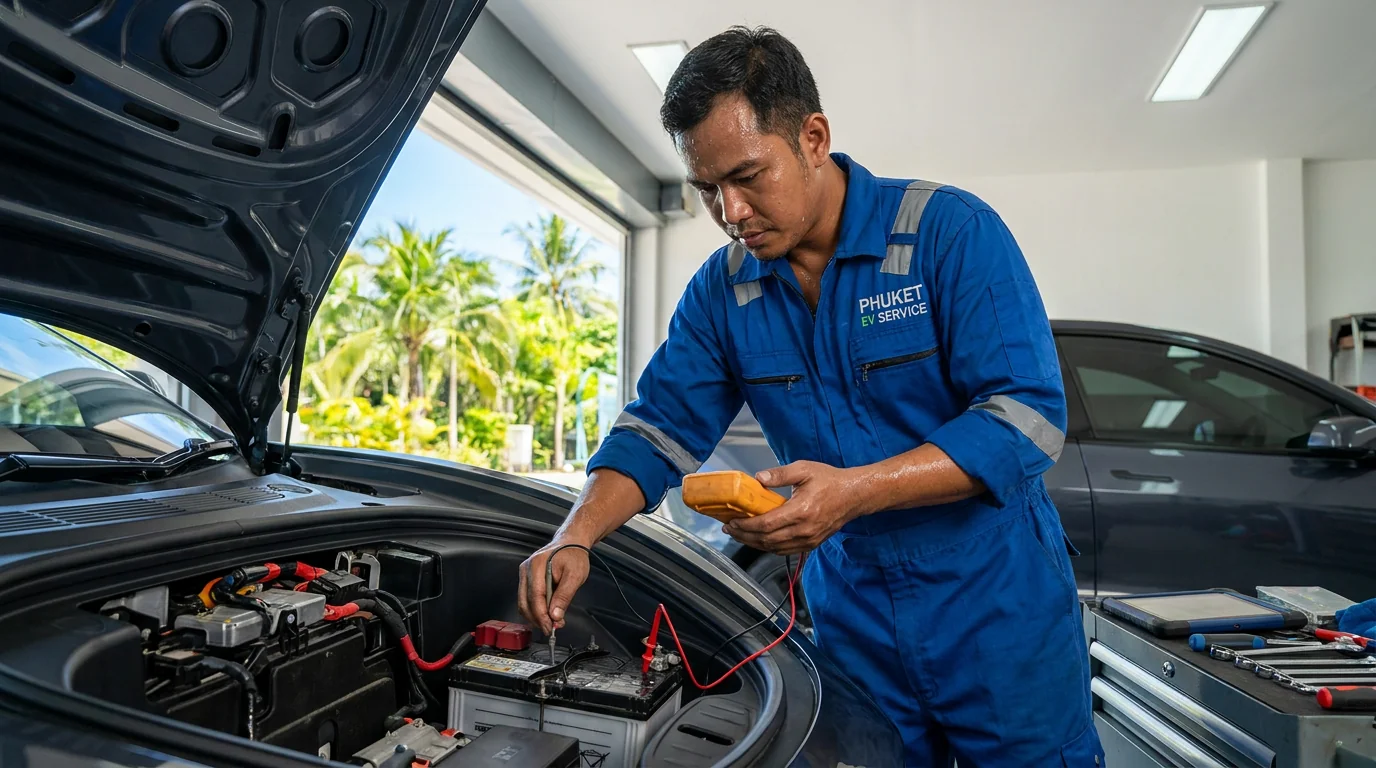
Phuket is one of the hottest, most humid places in Thailand — ambient temperatures of 28-34°C, and 50-60°C under the bonnet at midday. In that environment an EV’s 12V battery typically lasts 18-24 months, against a design expectation of 36-48.
These are the five habits that, in our experience replacing these batteries across the island, reliably push that past two years.
Why EV 12V Batteries Die Faster Here
Heat and humidity
Ambient 28-34°C, relative humidity 70-85%, and 50-60°C under the bonnet at midday. Chemical degradation runs roughly twice as fast as in a temperate climate. As a rule of thumb, lead-acid battery life halves for every 10°C above 25°C.
EV systems never fully sleep
Sentry Mode (Tesla), cabin overheat protection, app wake-ups, over-the-air update checks, BMS cell monitoring, telematics. All of it draws from the 12V while the car is parked.
The 12V in an EV is small
Most are 35-70Ah, against 45-100Ah in a petrol car. Manufacturers size them on the assumption they’re lightly used. In practice they’re worked hard.
There’s no alternator
A petrol car’s alternator charges the 12V constantly whenever the engine runs. An EV’s DC-DC converter only tops up the 12V when the high-voltage system is awake. Park for long enough and nothing is charging it at all.
The Five Habits
1. Turn off Sentry Mode and cabin overheat protection when you don’t need them
Tesla: switch Sentry Mode off when parked somewhere safe — home, your hotel. Switch off Cabin Overheat Protection when parked in shade. Keep both for long stays in public car parks, which is what they’re for.
BYD, MG, Volvo, Geely: disable remote app connection when you’re not using it, and cabin pre-conditioning if you don’t need it.
Sentry Mode in particular is the single most common reason we find a Tesla 12V dead early in Phuket.
2. Park in shade — this is the biggest single win
Park in a garage or under a building. Use a sunshade in open parking, or a reflective cover.
The effect: under-bonnet temperature drops from around 60°C to around 40°C, which extends 12V life by roughly 30-40%. Nothing else on this list comes close for effort versus result.
3. Don’t leave the traction battery below 30% when parking long-term
The main pack’s BMS needs energy from the high-voltage side to operate. If the traction battery’s state of charge is low, the BMS stops maintaining things, the DC-DC converter stops topping up the 12V, and the 12V slides into deep discharge — which permanently damages it.
- Charge the traction pack to at least 50-80% before leaving the car
- Parking 5+ days: charge to 80%
- Parking 10+ days: use a trickle charger on the 12V, or leave the car plugged in
4. Drive at least 30 minutes a week
The DC-DC converter only charges the 12V while the high-voltage system is awake. Driving charges it; not driving doesn’t.
- 30 minutes of driving per week is the practical minimum
- Alternatively, leave the car in “stay on” mode for 30 minutes — the HV system runs without moving
- Don’t just switch the infotainment on. That draws from the 12V without charging it, which is worse than doing nothing.
5. Get the 12V health-checked every 6 months
At EV Phuket this includes open-circuit voltage, CCA (cold cranking amps), a load test, and a terminal and corrosion inspection. The check is free.
Signs it’s already weakening:
- Doors slow to unlock
- Screen takes noticeably longer to boot
- App connects slowly or times out
- “12V Battery Low” warning
- Car parked 3-5 days and it’s flat
That last one is the clearest signal. A healthy 12V in an EV should survive well over a week parked.
Maintenance Calendar
| Interval | What to do |
|---|---|
| Weekly | Drive 30+ minutes; glance at the battery and terminals |
| Monthly | Note any slow door unlock or slow screen boot |
| Every 3 months | Inspect and clean terminals (important near the coast) |
| Every 6 months | Free 12V health check at EV Phuket |
| Every 12 months | CCA and load test |
| Every 18-24 months | Plan a replacement |
Replacing proactively at 20-24 months costs the same as replacing reactively — minus the ruined evening.
12V Replacement Prices in Phuket
| EV brand | Battery type | Size | Price |
|---|---|---|---|
| BYD (all models) | AGM | 35-60Ah | ฿2,500 - ฿3,500 |
| Tesla Model 3 / Y | AGM / Li-ion | 70Ah | ฿4,500 - ฿5,500 |
| Volvo EX30 | Li-ion (specialist) | 12Ah | ฿4,500 - ฿6,500 |
| MG ZS EV / MG4 | AGM | 60Ah | ฿2,500 - ฿3,400 |
| NETA V / X | AGM | 45-60Ah | ฿2,900 - ฿3,400 |
| Geely EX2 / EX5 | AGM | 45Ah | ฿2,500 - ฿3,000 |
| Hyundai Ioniq 5 / 6 | AGM | 70Ah | ฿3,200 - ฿3,800 |
| Kia EV5 / EV6 | AGM | 60-70Ah | ฿3,200 - ฿3,800 |
All prices include the battery, fitting, BMS reset, call-out and a 1-2 year warranty depending on brand.
EV Phuket — 12V Specialists
- Free 12V health check
- Replacement for every brand, including AGM, flooded and specialist lithium
- BMS reset after fitting, which many workshops skip
- 24-hour mobile service, with us reaching you in 20-30 minutes
- 1-2 year warranty depending on brand
Call 098-168-9907 — anywhere in Phuket
Related Reading
- Home Wall Charger Installation Guide - keeping the car plugged in helps the 12V too
- Used EV Buying Checklist - what to check before you buy
- Car Battery Replacement Cost 2026 - full price guide
- EV Battery Service - all brands
Sources: EV Phuket customer data 2024-2026, BYD / Tesla / Volvo owner’s manuals, Battery Council International.