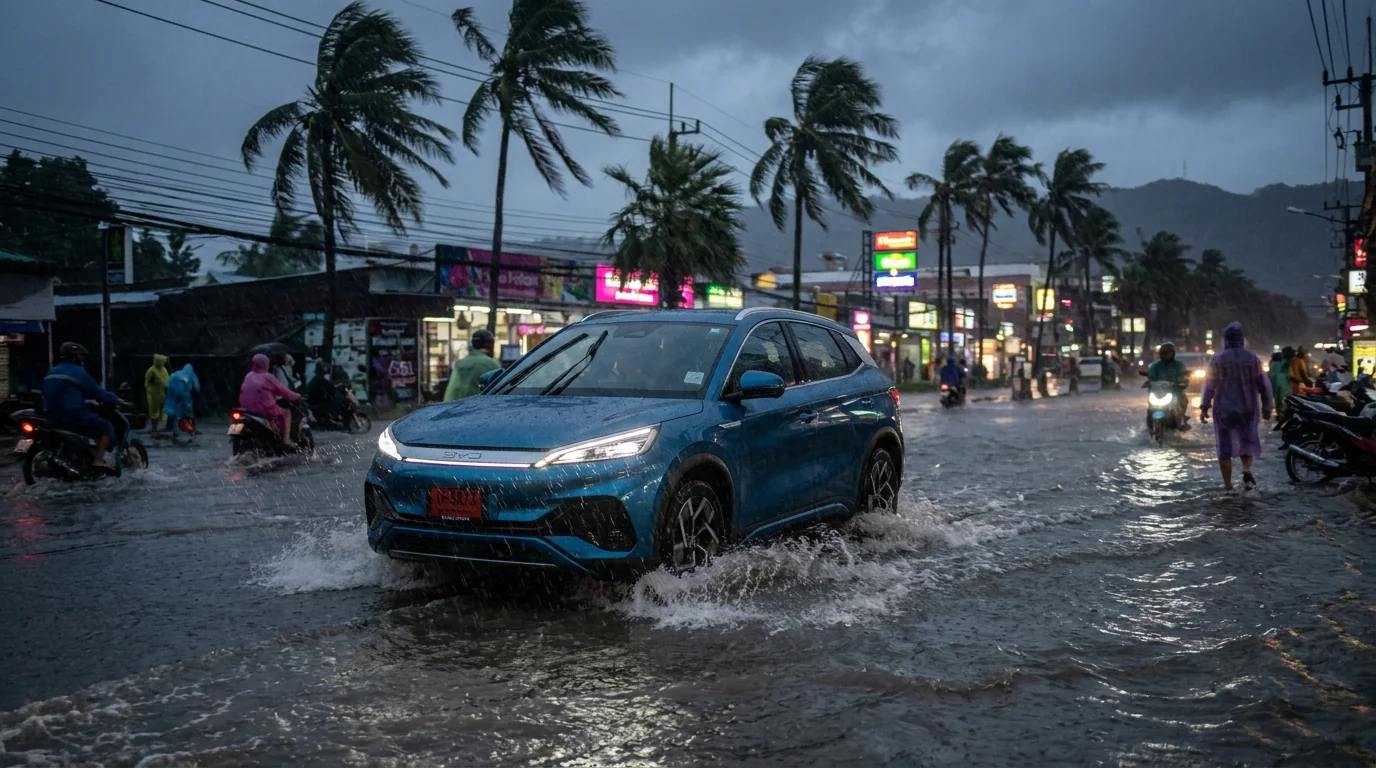
Phuket’s monsoon runs May to October, and low-lying areas — Patong, Kathu and Phuket Town — flood reliably. EV owners need to take this more seriously than petrol car owners, for one blunt reason: flood damage to a traction battery can cost up to ฿1.5 million to repair.
This guide is about avoiding that.
Flood Risk by Area
| Area | Risk | Why |
|---|---|---|
| Patong | Very high | Low-lying, undersized drainage |
| Kathu | Very high | Flat, low ground |
| Phuket Town (Old Town) | High | Old buildings, slow drainage |
| Rawai | Moderate | Close to sea level |
| Chalong | Moderate | Certain spots only |
| Thepkrasattri corridor | Lower | Better drainage |
| Bang Tao | Lower | Higher ground |
| Laguna | Low | Higher ground |
Monthly rainfall
| Month | Rainfall |
|---|---|
| May | 150-250 mm |
| June | 250-350 mm |
| July | 280-400 mm |
| August | 280-450 mm |
| September | 350-500 mm — the peak |
| October | 280-400 mm |
September is when we get the most flood-related callouts by a wide margin. If you’re planning to be away, that’s the month to leave the car somewhere elevated.
What IP67 Actually Means — And Doesn’t
| Rating | What it certifies |
|---|---|
| IP67 | Dust-tight; survives immersion in 1 m of water for 30 minutes |
| IP68 | Dust-tight; survives immersion beyond 1 m for longer than 30 minutes |
| IP69K | Withstands high-pressure water jets |
Ratings on EVs sold in Thailand
| Model | IP rating |
|---|---|
| BYD Atto 3 | IP67 |
| BYD Sealion 7 | IP68 |
| MG ZS EV | IP67 |
| Tesla Model 3 / Y | IP67 |
| Volvo EX30 | IP68 |
| Geely EX2 | IP67 |
| Toyota Hilux Travo EV | IP68 |
The dangerous misunderstanding
“IP67 means I can drive through any depth.” No. Here’s why the rating doesn’t transfer to real flood water:
- IP67 is tested in clean, still water with the vehicle stationary
- Real flood water carries silt, debris, chemicals and — near the coast — salt
- A spinning motor creates negative pressure that can actively draw water in
- Seals and connectors age. A three-year-old car in tropical humidity does not seal like a new one
The rating describes a laboratory condition. Flood water is not that condition.
Safe depths, honestly
| Water depth | What to do |
|---|---|
| 0-15 cm | Drive slowly — fine for most EVs |
| 15-30 cm | Very slowly, and accept some risk. Pickup EVs cope better |
| 30-50 cm | Dangerous — find another route |
| Over 50 cm | Do not drive. Turn around. |
What Flood Damage Actually Costs
These are real cases, not hypotheticals:
BYD Atto 3, 40 cm of water (April 2025, Phuket) — water entered the battery module, insulation system damaged, four modules replaced. Repair: ฿1,200,000.
Tesla Model Y, 30 cm (June 2025, Bangkok) — water entered the rear motor, drive unit replaced. Repair: ฿800,000.
MG ZS EV, 20 cm (July 2025, Phuket) — water reached the 12V battery bay, infotainment failed. Repair: ฿180,000.
Note the pattern: 20 cm cost ฿180,000. The depth at which people assume they’re safe is already expensive.
Ten Habits for the Rainy Season
Before the season starts
- Check every door seal for cracks or hardening
- Check the underbody skid plate is intact and properly fastened
- Replace tyres below 3 mm — aquaplaning risk rises sharply
- Test lights and wipers properly, not just casually
Driving in rain
- Reduce regenerative braking. Strong regen on a wet road can unsettle the car more than people expect — the deceleration comes only from the driven axle
- Slow down 20-30%
- Low beams plus fog lights — visibility to others matters more than your own
- Increase following distance substantially
If you meet flood water
- Do not enter water deeper than 30 cm
- If you absolutely must, go very slowly — 5-10 km/h — and don’t stop. Stopping mid-water lets water settle into places moving water doesn’t reach
After driving through water
Immediately, before going home:
- Stop as soon as it’s safe
- Power the car off
- Check for warning lights
- If you smell anything burning, call for help rather than driving on
Once home:
- Inspect underneath the car
- Check doors and seals
- Bring it to us for inspection
- Do not plug it in to charge if you suspect water ingress. Charging a wet high-voltage system is how a ฿180,000 repair becomes a ฿1,200,000 one
Does Insurance Cover It?
Comprehensive (Class 1) policies in Thailand:
- Flood damage — covered
- Fire — covered
- Subject to a “reasonable driving” condition
- Generally not covered if you drove into water deeper than about 30 cm
That exclusion is the crux. Insurance covers being flooded; it does not reliably cover choosing to drive into a flood.
To support a claim, gather:
- Photographs of the car in the water, if it’s safe to take them
- A weather report for the date
- An inspection certificate from a qualified EV workshop
- A written damage report
Timelines: typically 2-4 weeks; complex cases 2-3 months.
Sentry Mode and Heavy Rain
A Phuket-specific problem worth knowing: heavy rain triggers Tesla’s Sentry Mode, which then records continuously and drains the 12V battery fast. In a storm the cameras may also misread conditions.
Fix: turn Sentry Mode off during the rainy season, and enable it only when parked somewhere you actually have a security concern.
Where Not to Park in Heavy Rain
Avoid these in Phuket:
- Central Phuket underground parking — has flooded
- Jungceylon underground parking — has flooded
- Beachfront parking in Patong — combined tide and rain
- Under older buildings in Phuket Town — slow drainage
- Under large trees — storm winds bring branches down, and an EV’s roof often houses sensors
Park on higher, open ground during heavy rain warnings, even if it means walking further.
EV Phuket — Rainy Season Support
- Post-flood inspection before you charge the car
- 12V health check — free
- 12V replacement, all EV brands
- Written condition report for insurance claims
- 24-hour mobile service, 20-30 minute arrival
If your EV has been in water, call before you charge it.
Call 098-168-9907 — anywhere in Phuket
Related Reading
- EV 12V Battery Care in Phuket - heat and humidity year-round
- Used EV Buying Checklist - never buy a flood-damaged EV
- Home Wall Charger Installation Guide - weatherproofing matters here
- EV Battery Service - all brands
Sources: Thai Meteorological Department rainfall data, manufacturer IP specifications, EV Phuket repair case records 2024-2026.