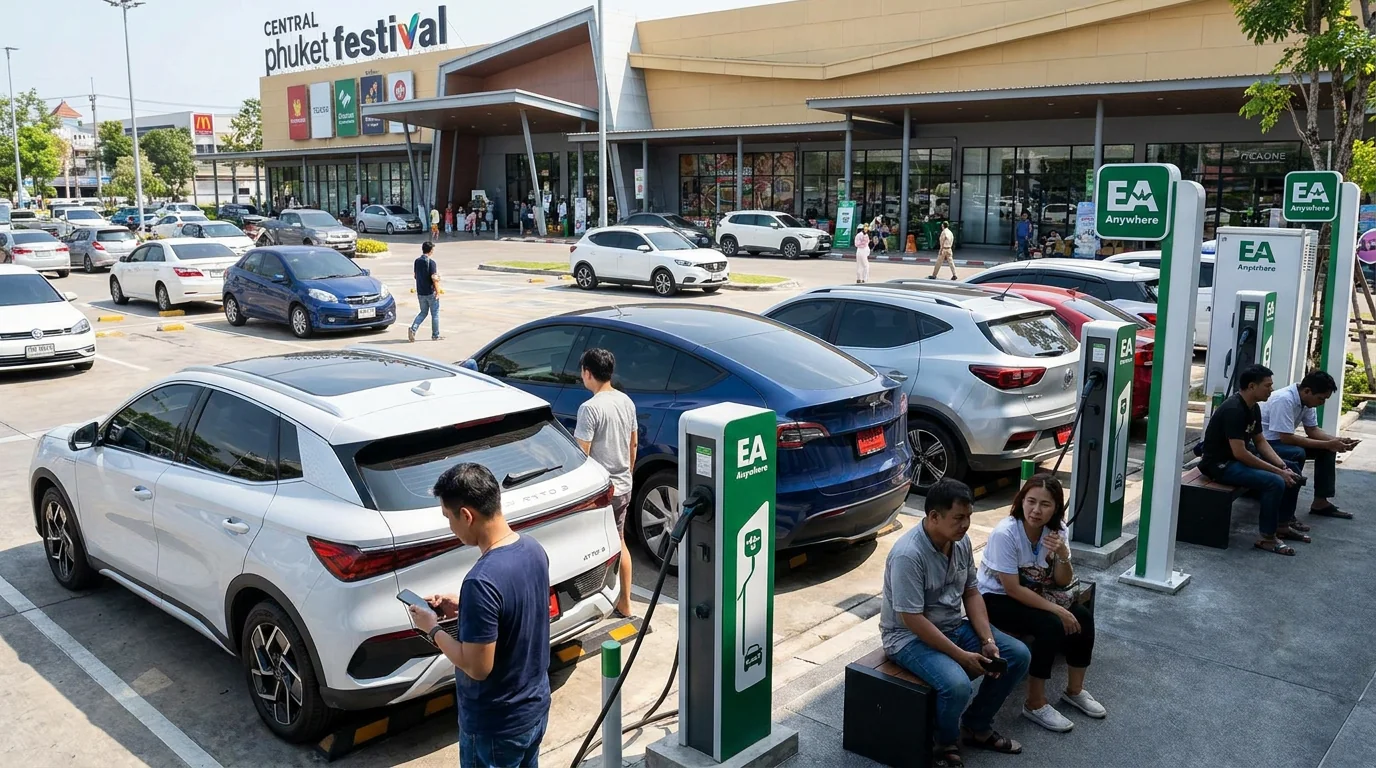
Thailand has nearly 300,000 EVs on the road in 2026, and fewer than 5,000 DC fast-charging outlets nationwide. That ratio is the whole problem, and it’s why arguments at charging stations have become common enough to make the news.
Most of these situations are avoidable with rules that take no effort to follow.
What Actually Happens When Nobody Follows Them
- April 2026 — two owners in a public argument at a PTT station in Chonburi
- March 2026 — a Tesla left plugged in and unattended was deliberately hit at Siam Paragon
- February 2026 — petrol cars photographed blocking EV bays
- January 2026 — 90-minute queues at EA Anywhere over New Year
The cost isn’t just your afternoon. These incidents go viral, they make prospective EV buyers nervous, and occasionally they end in damaged property.
The Ten Rules
1. Stop at 80% when there’s a queue
Charging from 80% to 100% takes disproportionately long — the charge curve flattens dramatically — so you occupy the bay for a long time for very little added range.
Exception: no queue means charge to 100% freely. If you genuinely need a full charge to continue a long journey, tell whoever is waiting.
2. Move your car the moment charging finishes
Leaving a finished car plugged in blocks everyone behind you. Several networks now charge idle fees — PTT at ฿10 per minute, Tesla at ฿1 per minute — so it costs you as well.
How: set an alert in the app, choose a charger near where you’ll be waiting, and come back before it finishes rather than after.
3. Respect the queue
First come, first served. Pushing in is the single most reliable way to start an argument.
How: get out and ask who arrived first. If it’s unclear, the app history can settle it. If there’s a real dispute, ask a site manager rather than escalating it yourself.
4. Put the connector back properly
A cable left on the ground gets driven over, which damages the charger and leaves the next person dealing with it.
How: return the connector to its holster, close the charger’s flap, and check the status light shows “available” before you leave.
5. EV bays are for charging EVs
A petrol car parked in an EV bay is guaranteed conflict — and under current Thai regulations it’s an offence carrying a ฿2,000 fine.
If you drive an EV: use the bay to charge, not to park. If you drive a petrol car: don’t use it at all.
6. Keep phone calls quiet
Chargers are usually in shared public space — mall car parks, petrol stations. Take the call in your car or use a headset.
7. Don’t use DC fast charging for a small top-up
DC chargers exist for topping up 50-80% on a journey. If you only need 30% and you’re near home, use AC. Leaving DC free for people actually travelling is the single most useful thing you can do for the network.
Exceptions: genuine emergencies, no AC charger nearby, or an empty station.
8. Take your rubbish with you
Chargers are hosted on someone else’s property — a mall, a petrol station. Sites that get messy sometimes get closed.
9. Report broken chargers immediately
An unreported fault means the next five drivers waste a trip. Call the operator’s hotline, use the “report issue” function in the app, and send a photo. It takes two minutes and it’s the most useful thing an EV owner can do for other EV owners.
10. Share the bay during peak periods
On holidays, queues get long. If you finish early, leave. Talk to the people waiting and agree on timing. Some apps support multi-user sessions — use them.
Don’t — Seriously
Don’t plug in and go for a long lunch somewhere else. Everyone behind you waits, and idle fees will apply.
Don’t charge to 100% during peak hours. It takes longest, costs the most (peak tariff), and blocks the most people.
Don’t argue at the charger. It ends up on TikTok, it damages the EV community’s reputation, and some operators will ban users over it.
Don’t vandalise EV chargers. This should not need saying, but incidents have occurred. It’s criminal damage and it sets everyone back.
Don’t share member-only access credentials. Some networks (Tesla, BMW) are member-restricted, and sharing access violates the terms.
Phuket-Specific Notes
Phuket has around 200+ charging points, which is comparatively good for the island’s size — but they concentrate in the same places everyone else goes: Central Phuket, Jungceylon, the airport, and the main resort strips.
Practical consequences:
- High season (November-February) queues at Patong and Central Phuket are worst between 17:00 and 21:00
- The island is only about 50 km end to end. For residents, home AC charging removes almost all need for public DC — which also frees capacity for visitors who genuinely need it
- During heavy rain, avoid the underground chargers at Central Phuket and Jungceylon: both have flooded before
One Thing That Isn’t Etiquette — It’s Your 12V
If you find yourself queuing at public chargers weekly, you’re also cycling your car’s electronics far more than someone who charges at home overnight. The battery that will eventually strand you at a charging station is the 12V auxiliary, not the traction pack — and a flat 12V means the car can’t wake up to negotiate with the charger at all.
If your car has been slow to wake, or you’ve seen a 12V warning, get it checked before your next long trip.
EV Phuket
- Free 12V health check
- 12V replacement, all EV brands, ฿2,500-6,500
- BMS reset after fitting
- 24-hour mobile service, 20-30 minute arrival
Call 098-168-9907 — anywhere in Phuket
Related Reading
- Home Wall Charger Installation Guide - the best way to avoid queues entirely
- EV 12V Battery Care in Phuket - five habits that double its life
- EV Care in Phuket’s Rainy Season - which chargers to avoid when it floods
- EV Battery Service - all brands
Sources: Thai EV registration data, PTT / EA Anywhere / Tesla tariff schedules, EV Phuket customer reports 2024-2026.