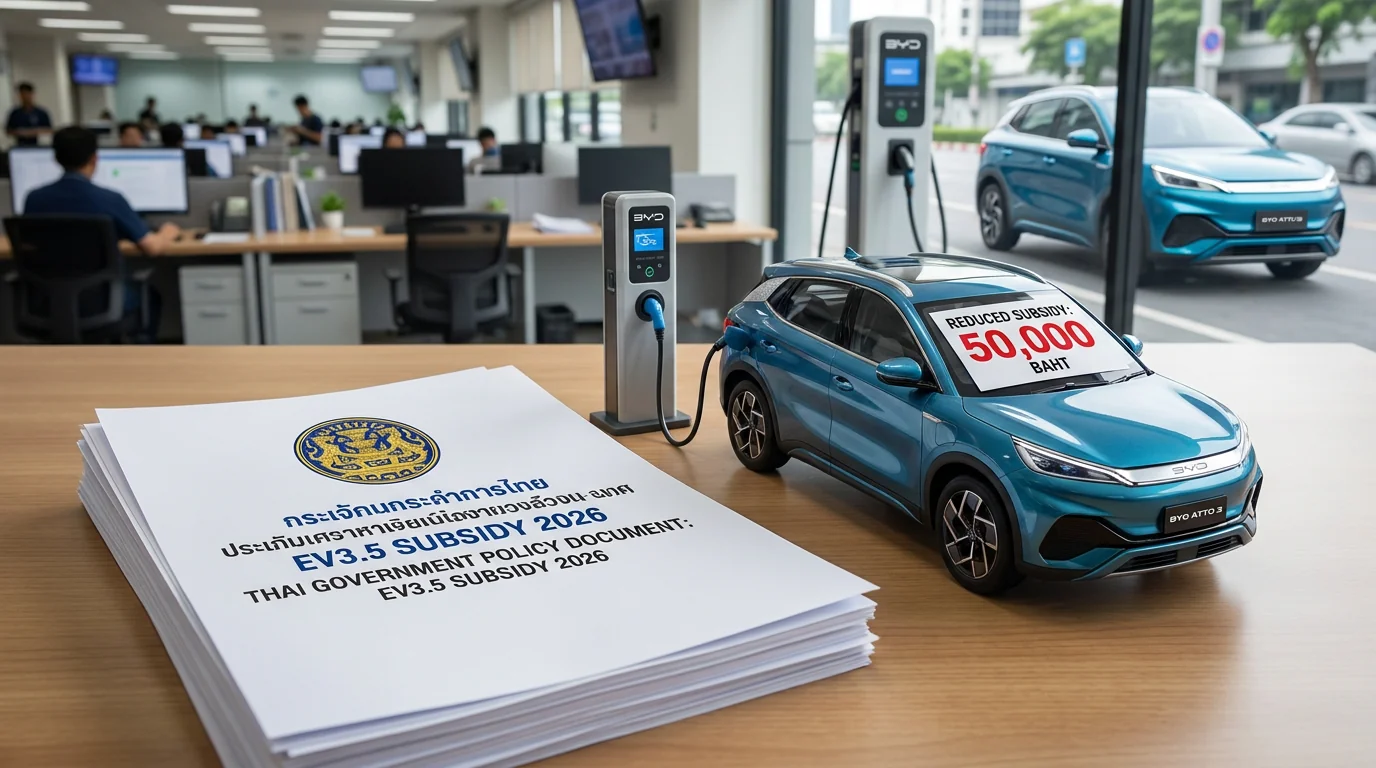
Thailand’s EV incentive did not disappear in 2026. It narrowed — and the narrowing did more to prices than the headline cut suggests.
What the subsidy is now
| Year | Subsidy per vehicle |
|---|---|
| 2024 | up to ฿100,000 |
| 2025 | up to ฿75,000 |
| 2026 | ฿50,000 |
Two conditions matter as much as the amount:
- The car must be assembled in Thailand. Imported EVs no longer qualify at all.
- The battery pack must be 50 kWh or larger.
EV3.5 runs from 2024 to 2027, with subsidies scaled between roughly ฿20,000 and ฿100,000 depending on battery size and year. The predecessor scheme, EV3, offered up to ฿150,000 and did cover imports — which is why the transition felt abrupt rather than gradual.
Why prices moved so much more than ฿50,000
A subsidy cut of ฿100,000 between EV3 and EV3.5 does not explain a ฿150,000-plus price rise on its own. Three things stacked:
1. The subsidy cut itself — up to ฿100,000 of list-price support removed for cars that previously qualified.
2. Imports lost eligibility entirely. A model built in China and shipped to Thailand went from partial support to none. That is a bigger step than the headline number.
3. Chinese makers were repricing globally. China moved against below-cost selling in early 2026, and industry margins had fallen to around 3.2% in Q1 — the January-February period hitting a decade low near 2.9%. More than 15 major manufacturers announced price rises on vehicles or options. Thailand was not singled out.
The result in the showroom:
| Model | Change |
|---|---|
| BYD Dolphin (standard) | +33% to ฿599,900 (as of 24 February 2026) |
| BYD Atto 3 | +21% to ฿849,900 |
→ The full February 2026 price rises
The timing trap that caught buyers
Cars registered by the end of January 2026 still fell under EV3 terms. Cars registered from February 2026 did not.
This is why January produced a record 44,000+ BEV sales and 48% penetration, and why February was so much quieter. The demand did not vanish — it had already been spent.
→ Why January 2026 was a record — and a one-off
What this means if you are buying now
Ask whether the car is locally assembled before you ask anything else. It determines whether the subsidy applies at all, and it is not always obvious from the badge — several brands sell both CKD and imported variants of the same nameplate.
The list price is still not the number. Even after the rises, campaign discounts of ฿80,000-130,000 remained real during motor show periods. Never open a negotiation from the sticker.
Cheap does not stay cheap. A brand competing purely on price without the balance sheet to sustain it is a long-term risk. NETA’s collapse in Thailand is the clearest illustration. → When a car brand disappears
Budget for what no subsidy ever covered. The 12V battery lasts roughly 18-24 months in Phuket and costs ฿2,500-6,500 to replace, and no warranty covers it.
EV Phuket — mobile EV battery service
- 12V battery replacement for all EV brands, including system reset
- Free 12V health check — voltage, CCA and load test
- Pre-purchase inspection for used EVs with a written health certificate — ฿1,500-3,000
- 20-30 minutes anywhere in Phuket
Call 098-168-9907
→ Choosing and running an EV in Phuket
Sources: Thailand EV Board / BOI EV3 and EV3.5 terms, ChinaEVHome February 2026 Thailand pricing, China Passenger Car Association Q1 2026 margin data, BYD Thailand official pricing — verified August 2026.