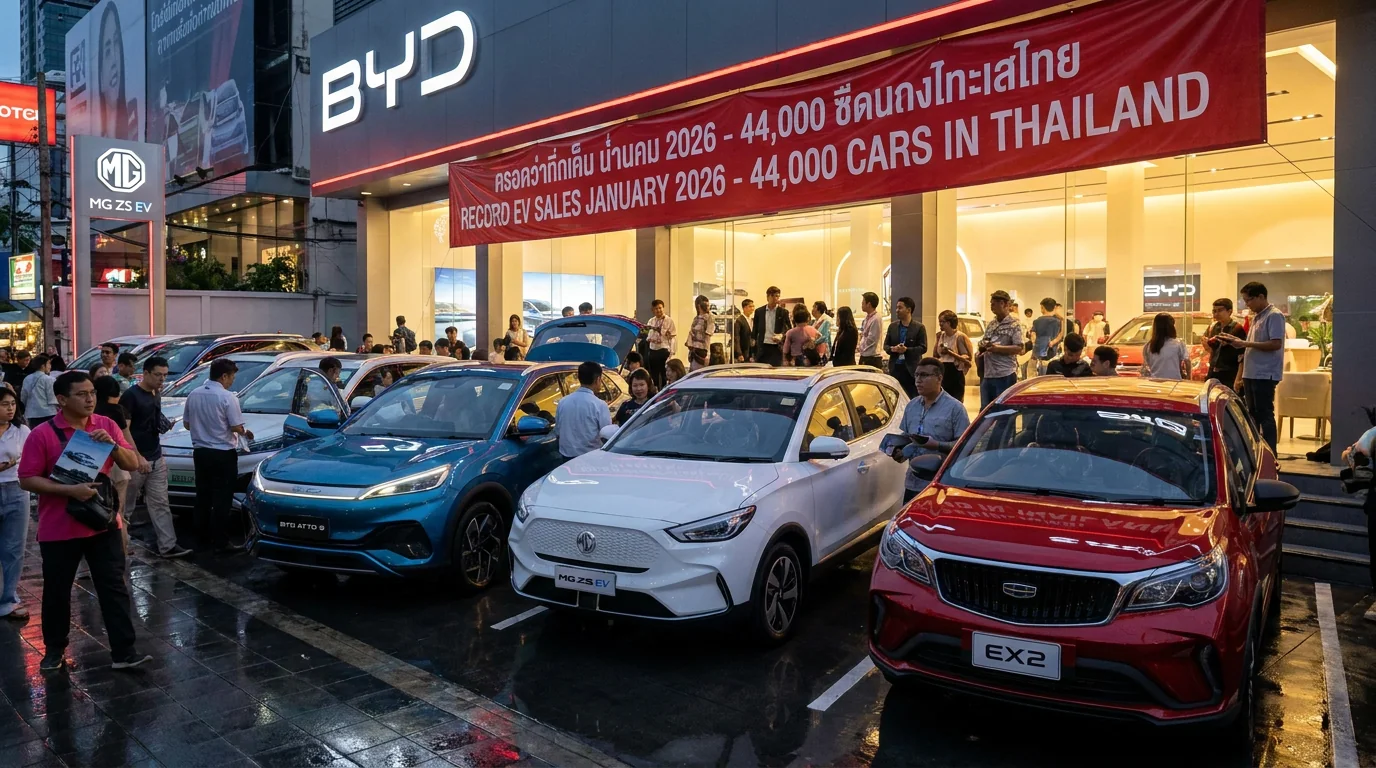
Thailand’s battery-electric sales more than tripled year-on-year to over 44,000 units in January 2026, the highest month the country has recorded. BEV penetration reached 48%, beating the previous record of 37% set in December 2025.
The number is real. But the reason behind it is what actually tells you something, and most coverage skipped it.
This was a registration deadline, not a demand surge
The EV3 incentive scheme was due to close at the end of December 2025. In November 2025 the government extended the registration deadline to the end of January 2026.
That extension is the whole story. Manufacturers and dealers had one month to get already-sold cars registered before the more generous EV3 terms expired — so a large volume of vehicles that would normally have been spread across several months was compressed into a single reporting period.
Industry analysts flagged the spike as likely a one-off event, and the months that followed bore that out.
A second, smaller factor pushed in the same direction: from 1 January 2026 Thailand cut excise tax on battery-electric passenger cars from 8% to 2%, and on battery-electric pickups from 2% to 0%.
The numbers behind the month
| January 2026 | |
|---|---|
| BEV sales | 44,000+ units |
| BEV penetration | 48% (previous record 37%, Dec 2025) |
| Total e-mobility registrations | 45,668 (+210.4% YoY) |
| Chinese brands combined | 42,251 units — 46.8% of the market |
| BYD | 12,791 units, +193.7%, 14.2% share — 2nd overall |
Chinese brands took 46.8% of the Thai market in January, against 20.2% a year earlier. BYD’s previous best had been 6,370 units and 11.9% share in June 2025 — it roughly doubled both in a single month.
→ How BYD reached second place in the Thai market
What happened next — and why it matters more
If you only read the January headline, you would conclude the Thai EV market was in a straight-line boom. It wasn’t.
From February 2026 the EV3.5 scheme replaced EV3, cutting the subsidy to ฿50,000 and restricting it to locally assembled cars with packs of 50 kWh or larger. Chinese brands raised Thai prices immediately — the BYD Dolphin by 33% and the Atto 3 by 21% — and the market that had looked unstoppable in January went quiet.
→ What EV3.5 did to Thai EV prices · Chinese EV price rises, February 2026
The practical lesson for buyers: in a market where policy deadlines move this much volume, the month you buy in matters as much as the model you choose.
What a record month means for owners in Phuket
A very large cohort of EVs entered the Thai fleet in a single month. Two consequences follow directly, and both land here:
Charging gets tighter before it gets easier. New cars arrive faster than new chargers. In Phuket that pressure compounds with tourist seasonality, because the island has few main roads and demand is not spread evenly across the year. → Where to charge in Phuket
12V batteries come due together. In Phuket’s heat a 12V battery lasts roughly 18-24 months. A registration spike in January 2026 means an unusually large group of cars reaching that point across mid-to-late 2027 — and no manufacturer warranty covers it. → Caring for your EV’s 12V battery in Phuket
EV Phuket — mobile EV battery service
- 12V battery replacement for all EV brands, including system reset
- Free 12V health check — voltage, CCA and load test
- 24-hour emergency jump start (cars only, no motorcycles)
- 20-30 minutes anywhere in Phuket
Call 098-168-9907
→ Choosing and running an EV in Phuket
Sources: Benchmark Mineral Intelligence (January 2026 Thailand EV sales), MarkLines Thailand e-mobility registrations January 2026, Best Selling Cars Blog Thailand January 2026, Thailand excise tax changes effective 1 January 2026, Thailand EV Board / BOI EV3 and EV3.5 terms — verified August 2026.