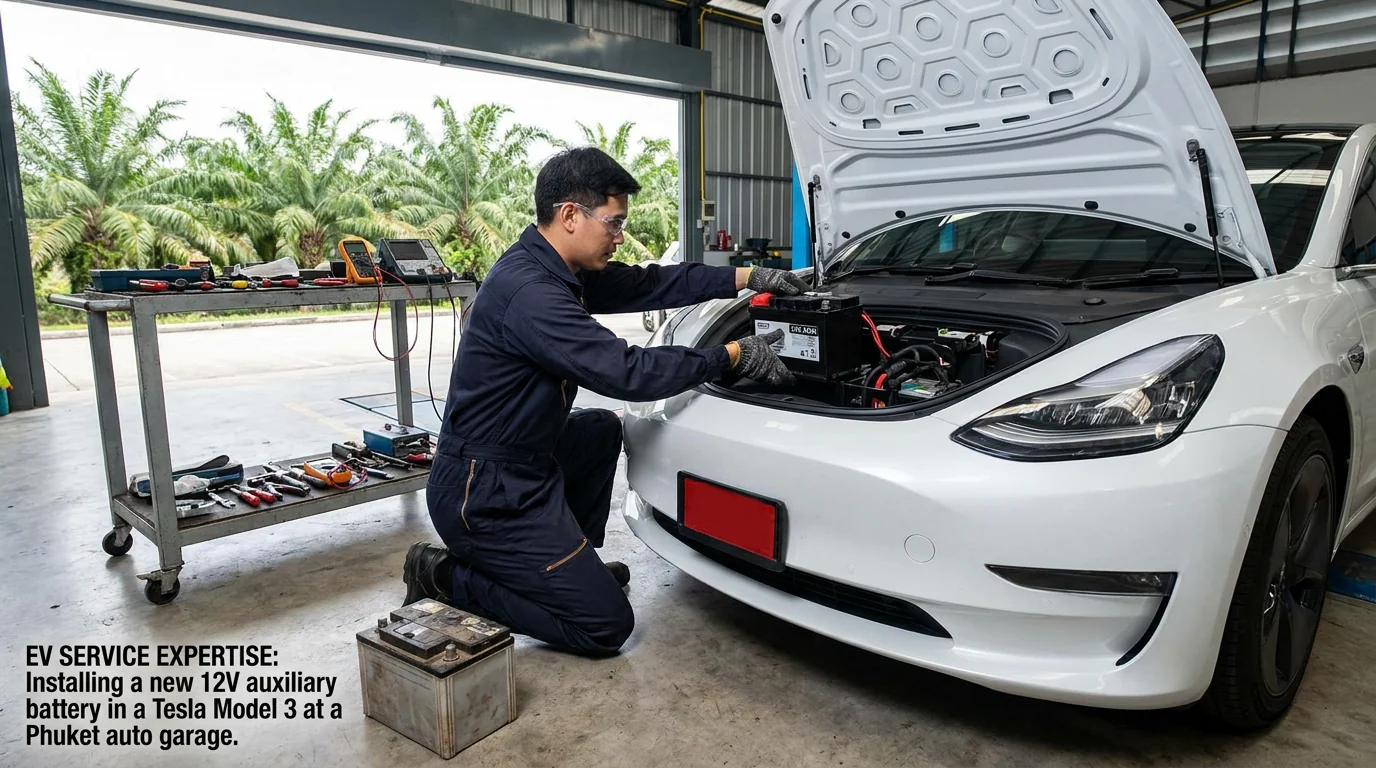
Everyone talks about the traction pack and its 400-700 km of range. What actually strands EVs in Phuket is the 12V battery — a part that costs a few thousand baht.
More than half of the emergency calls we take are 12V, not high-voltage. And nearly all of them involve cars whose main pack was still above 50%.
Why an EV still needs a 12V battery
The high-voltage pack can only deliver power once the contactors inside it are commanded closed — and everything capable of issuing that command runs on 12V:
- Waking the BMS and closing the contactors — the first step in “starting” an EV
- Electric door locks and powered handles
- Centre screen, communications, telematics module
- Safety systems — airbags, ABS sensors, control modules
If the 12V dies, the car won’t open at all, even with the main pack at 100% — because nothing is left to tell that pack to start supplying power. A full fuel tank with no key.
Four reasons EV 12V batteries die faster than in petrol cars
1. There is no alternator
- Petrol car: the alternator feeds the 12V continuously whenever the engine runs
- EV: a DC-DC converter steps high-voltage down to 12V — but only while the car is awake
- Parked and asleep means the 12V receives nothing, while various systems keep drawing from it
2. The car wakes itself around the clock
A parked petrol car is genuinely asleep. An EV wakes periodically to:
- Check for OTA updates
- Answer the mobile app when the owner opens it
- Monitor the main pack’s cells
- Run sentry/security cameras
- Run cabin overheat protection
Every wake-up draws from the 12V. If it wakes more often than the DC-DC converter can top it back up, the battery drifts steadily deeper.
3. The battery is smaller than it should be
- Petrol cars: 45-100Ah, because cranking needs enormous current
- EVs: typically 35-70Ah, because manufacturers reason that there’s no engine to crank
- In practice an EV needs more reserve capacity, not less, precisely because there’s no alternator constantly replenishing it. The sizing logic runs against how the car is actually used
4. Phuket heat
- Under-bonnet temperatures reach 50-60°C at midday
- AGM batteries here last around 18-24 months, against a 36-48 month norm
- Plain flooded lead-acid may not see a full year
Real per-brand specs (know this before replacing)
Tesla Model 3 / Model Y — important: there are two completely different batteries
| Build years | Type | Spec | What it means |
|---|---|---|---|
| 2017-2020 | Lead-acid / AGM | approx. 45Ah, 650 CCA (group 51R / 85B24LS) | 2-4 years typically, less in Phuket. Conventional replacement |
| 2021 onwards | Lithium-ion | approx. 15.5V, 6.9Ah, 99 Wh — four NMC cells with control electronics and a LIN bus connection | Not a conventional 12V battery. An AGM cannot be substituted. Much longer life, but fails through deep discharge or electronics rather than age |
This is the single most common misunderstanding we encounter — people searching for a “70Ah Tesla 12V battery,” which does not exist. Always establish the build year first.
What we see in Phuket: sentry/camera monitoring left running during airport parking, plus cabin overheat protection working far harder here than it would elsewhere.
Volvo EX30 — the most unusual case on the market
- Uses a lithium 12V of roughly 12Ah, not an AGM
- Very small relative to the number of systems it has to support
- Harder to source outside the dealer network than any other brand here, and the most expensive line in the table below
- If you’re considering a used EX30, this is a running cost worth knowing in advance
BYD (Atto 1/2/3, Dolphin, Seal, Sealion, M6)
- AGM 35-60Ah depending on model — entirely standard and easy to source
- Typical symptom: won’t wake after 7-10 days parked, especially for owners who check the app frequently
- The upside: a generic part, so you are not tied to a dealer
MG (ZS EV, MG4)
- AGM 60Ah — though some batches shipped with plain flooded lead-acid
- If yours is flooded lead-acid, upgrade to AGM at replacement time. It handles deep cycling and heat considerably better for a small price difference
NETA, ORA, AION, Geely, Zeekr, XPeng
- Mostly AGM 45-60Ah
- ADAS and telematics keep these cars waking frequently
- Relevant for NETA owners: whatever happens with the parent company’s reorganisation, the 12V is a generic part — no waiting on shipments from China
12V replacement pricing in Phuket
| Brand / model | Type | Size | Price |
|---|---|---|---|
| All BYD models | AGM | 35-60Ah | ฿2,500-3,500 |
| Tesla Model 3 / Y | AGM or lithium (by year) | 45Ah / 6.9Ah-15.5V | ฿4,500-5,500 |
| Tesla Model S / X | AGM | — | ฿5,500-6,500 |
| Volvo EX30 | Lithium (model-specific) | ~12Ah | ฿4,500-6,500 |
| Volvo EX90 | AGM | 80-92Ah | ฿4,800-6,200 |
| MG ZS EV / MG4 | AGM | 60Ah | ฿2,500-3,400 |
| NETA V / X | AGM | 45-60Ah | ฿2,900-3,400 |
| Hyundai IONIQ 5/6 | AGM | 70Ah | ฿3,200-3,800 |
| Kia EV5 / EV6 | AGM | 60-70Ah | ฿3,200-3,800 |
All prices include the correct battery for the model, fitting, system reset, in-town call-out and a 1-2 year warranty.
Why the system reset matters: many cars store a learned state for the old battery. Without a reset the car keeps treating the new battery as aged and charges it on the wrong profile, shortening its life.
Preventing a dead car
Before parking for 5+ days (airport parking especially)
- Turn off always-on sentry/camera monitoring if the car is somewhere already covered by CCTV
- Turn off cabin overheat protection if parked in shade — it works far harder in Phuket than most owners realise
- Stop checking the app repeatedly. Every check wakes the car. This is the most overlooked cause of all
- Leave the main pack at roughly 50-60%. Too low and the car will refuse to top up the 12V
- Park in shade where you have the option
Warning signs the 12V is near the end
- Handles and doors respond more slowly on unlock
- The centre screen takes longer to come up
- The app connects slowly or drops out more often
- A low-voltage warning appears on the display
- The decisive one: the car won’t wake after only 5-7 days parked, while the battery is under two years old
A checking schedule that suits Phuket
| Interval | What to do |
|---|---|
| Every 6 months | Voltage and CCA check (we do this free) |
| After 18 months | Check more often — you’re into the Phuket risk window |
| Before a long trip or airport parking | Test before you leave, not after you come back to a dead car |
What to do if the 12V has already died
- Get into the car first. Almost every model has a mechanical emergency key hidden inside the fob and a keyhole usually concealed under a cap on the driver’s door handle. Find out how yours works before you need it
- Do not jump it like a petrol car. Many EVs have designated jump points that are not the battery terminals, plus current limits. Connecting to the wrong point can damage electronic modules
- Call someone who works on EVs specifically — the jump point location and wake-up sequence differ by model
EV Phuket — Mobile 12V Replacement, Island-Wide
Every brand: BYD, Tesla, Volvo, MG, NETA, Hyundai, Kia, AION, XPeng, Zeekr, Wuling, Geely, ORA, Chery and more.
- 20-30 minute arrival anywhere in Phuket
- Model-specific lithium units stocked for the Volvo EX30 and other unusual systems
- System reset after every replacement
- Free 12V health check — voltage, CCA and load test
- 1-2 year warranty
- 24-hour emergency jump start (cars only — we don’t service motorcycles)
Call 098-168-9907
Related Reading
- Tesla Model 3/Y Recall - what Thai owners need to check
- Volvo EX30 Fire Case Study - the recall in detail
- EV Batteries in Heat and Humidity - why Phuket is harder on batteries
- Car Battery Replacement Cost - full Phuket pricing
Sources: EV Phuket service records, manufacturer owner’s manuals, Tesla low-voltage battery specifications, TeslaTap 12 Volt Battery Compendium, InsideEVs — verified July 2026.