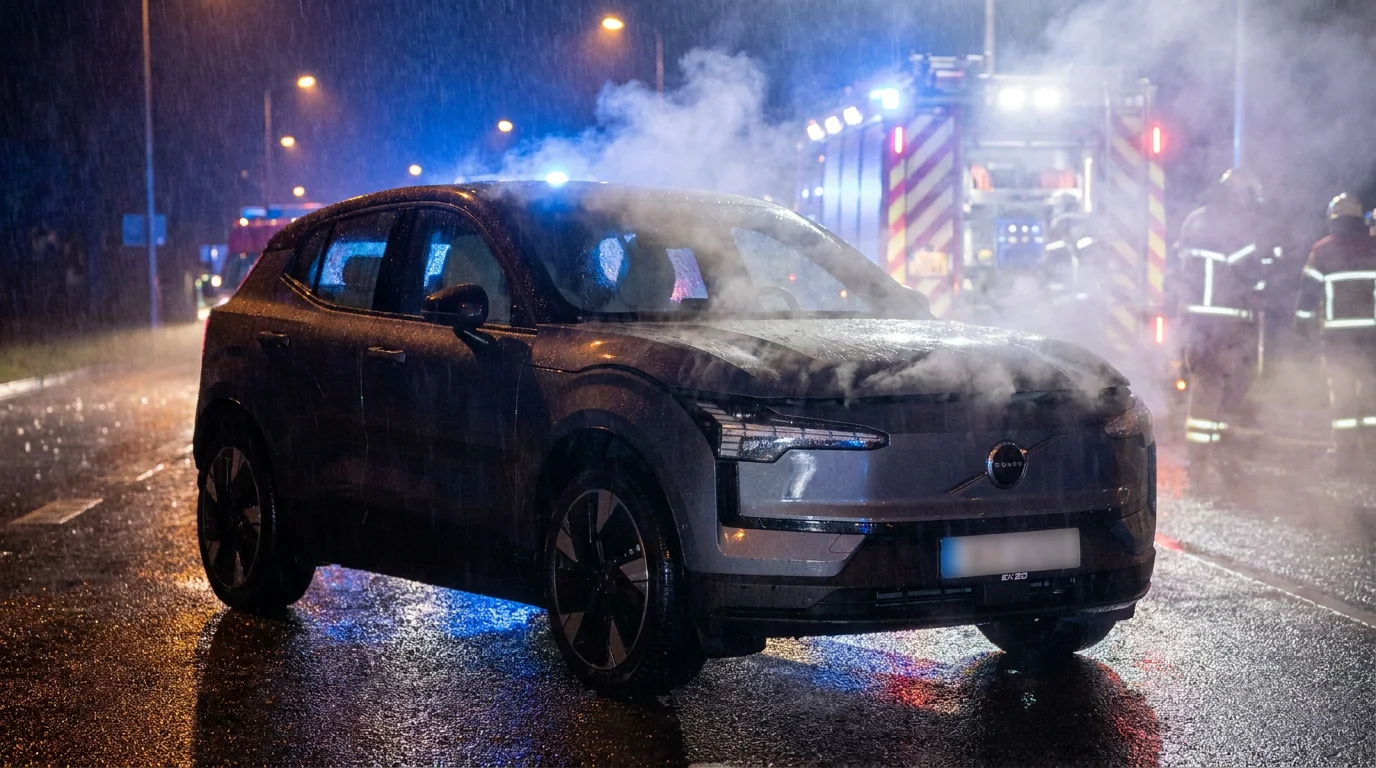
The Volvo EX30 recall is the most instructive EV battery case the Thai market has seen — not because of its size, but because of what it exposes: a single battery pack passes through three different companies, and when something goes wrong they point at each other while owners are told to cap charging at 70% and park away from buildings.
This piece is assembled from Volvo’s recall filings, OCPB announcements, Geely’s lawsuit against Sunwoda, and verifiable reporting. It also corrects several claims that circulated widely and led owners to misjudge the risk.
The verified timeline (Dec 2025 - Jun 2026)
26 December 2025 — the start most people never saw
VREMT (Viridi E-Mobility Technology), Geely’s battery subsidiary, sued Sunwoda Power for CNY 2.314 billion (~USD 323 million), alleging quality defects in cells supplied between June 2021 and December 2023.
That was the first signal, and it came before Volvo announced any recall. The case later settled, with Sunwoda paying CNY 608 million (~USD 89 million).
December 2025 — Volvo notifies owners
EX30 owners were advised to limit charging to 70% and park away from buildings until a fix was deployed.
January 2026 — recall notices issued
Volvo began issuing recall notices across markets including Australia, the US and Canada, citing a risk of the battery overheating and leading to thermal runaway and fire. NHTSA in the US stated the recalled vehicles were equipped with Sunwoda batteries.
25 February 2026 — Volvo confirms the number
The recall covers 40,323 vehicles in over a dozen countries, affecting Single Motor Extended Range and Twin Motor Performance variants, model years 2024-2026. The UK alone accounts for 10,440 cars.
20 March 2026 — the EX30 was not discontinued
The 2026 EX30 went on sale in China with a limited-time starting price of CNY 159,800 — contrary to rumours that Volvo was killing the model off.
15 May 2026 — fire in Thailand
An EX30 caught fire at around 21:00 while charging at the owner’s home. Volvo Car Thailand later stated that both Thai incidents involved recall-affected vehicles that had been charged beyond the recommended 70% limit.
21 May 2026 — the OCPB summons Volvo
Thailand’s Office of the Consumer Protection Board summoned Volvo Car Thailand, ordered safety testing with a 30-day reporting deadline, and signalled possible civil action seeking refunds and compensation. 45 consumer complaints had been filed.
PM’s Office Minister Supamas Isarabhakdi also demanded answers on the cause, the timeline for completing all 1,668 battery replacements, and compensation for affected owners.
25 May 2026 — module replacement begins in Thailand
Volvo began replacing battery modules (not entire packs) free of charge, taking roughly three days per car, targeting completion by August 2026, with courtesy vehicles and compensation for loss of use. EX30 sales were temporarily suspended.
18 June 2026 — the recall reaches China
The recall extended into the Chinese market, described there as: the dashboard may warn that the high-voltage battery is overheating, and the battery may emit smoke.
Corrections to what circulated
Several widely-shared claims were wrong, and some of them caused owners to misjudge their exposure:
| What was said | What the filings show |
|---|---|
| ”Defective CATL cells” | Not CATL. The cells were made by Shandong Geely Sunwoda Co., Ltd., a joint venture |
| ”It happened March-May 2025” | It began in late 2025; the Thai fires were in May 2026 |
| ”45 owners filed civil suits” | There were 45 complaints to the OCPB — and it is the OCPB weighing civil action |
| ”The whole pack gets replaced” | Only the modules inside the high-voltage pack |
| ”An 8-12 week wait” | About three days per car once booked; nationwide target of August 2026 |
| ”Volvo killed the EX30” | False — the 2026 EX30 launched in China in March 2026 |
| ”Every EX30 is at risk” | Only the 69 kWh pack, in Extended Range and Twin Motor Performance |
Why nobody would accept blame
What makes this an industry-level case study is that one battery passes through three parties:
| Layer | Responsible party |
|---|---|
| Cells | Shandong Geely Sunwoda Co., Ltd. — a JV in which Sunwoda holds only 30% and has no controlling power |
| Pack / system (BMS, thermal management, structure) | VREMT, Geely’s battery unit |
| Vehicle and duty to the customer | Volvo |
Sunwoda chairman Wang Wei said publicly that the packs in question “were not supplied by Sunwoda” but came from the Volvo/Geely in-house system factory, stressing that responsibility for integrating the complete battery system does not sit with Sunwoda.
At the same time, Geely’s own VREMT was suing Sunwoda for CNY 2.314 billion over cell quality — and settled for CNY 608 million. In civil terms, that is an acknowledgment that there was a real problem at cell level.
The lesson for owners: the badge on the bonnet doesn’t tell you who made the cells in your battery. A long liability chain slows remediation down. What actually protects you is the local distributor (Volvo Thailand) and the OCPB — not a cell manufacturer in another country.
The technical part: why only the 69 kWh pack
The EX30 has two batteries, and only one of them is in scope:
| Variant | Battery | Chemistry | Recall status |
|---|---|---|---|
| Single Motor (Core / Standard Range) | 51 kWh | LFP (lithium iron phosphate) | Not affected |
| Single Motor Extended Range | 69 kWh (~64 kWh usable) | NMC (nickel manganese cobalt) | Affected |
| Twin Motor Performance | 69 kWh | NMC | Affected |
The cause in the recall documentation is a cell manufacturing defect that can allow cells to overheat at a high state of charge. It is not a defect of NMC chemistry itself — NMC is used safely in hundreds of thousands of vehicles.
But the chemistry difference does explain why the interim measure is a 70% cap:
- NMC cells at high SOC sit at higher per-cell voltage and store more energy
- If an internal defect already exists, high-voltage conditions accelerate an internal short circuit
- Once shorted, heat rises fast enough to enter thermal runaway and propagate to neighbouring cells
- NMC releases oxygen during runaway, so the fire can sustain itself — LFP is thermally more stable
- Lithium battery fires are hard to extinguish and vent toxic gases (HF among them). The standard response is sustained cooling with large volumes of water, not a handheld extinguisher
Capping at 70% reduces stored energy and per-cell voltage to lower the chance of ignition. It is a risk-reduction measure, not a repair, and it is not a substitute for the module replacement.
What EX30 owners in Phuket should do
- Check whether your car is in scope. Single Motor Extended Range or Twin Motor Performance, MY2024-2026 — get the VIN checked with Volvo Thailand. Core / Standard Range with the 51 kWh LFP pack is not affected
- If you’re in scope and not yet fixed, respect the 70% cap strictly. Volvo itself stated both Thai fires involved cars charged beyond it. This is not boilerplate advice
- Park away from buildings, especially after charging. In Phuket that means avoiding charging in a garage under the house or in a condo basement
- Book the module replacement as early as you can. Roughly three days, courtesy car provided, compensation for loss of use — and the August 2026 nationwide target only gets tighter
- Keep every document — service bookings, handover sheets, receipts for costs incurred. If remediation ends up in a legal process, documentation is what counts
- If the dashboard warns of high-voltage battery overheating, or you smell or see smoke — stop in the open, away from buildings and other vehicles, get everyone out, and call 199. Don’t open panels and don’t try to fight it yourself
Phuket-specific risk factors
From a workshop that handles EV batteries on this island every day:
- 31-35°C year-round, and 50-60°C under the bonnet — a higher baseline than manufacturers design around. Both the traction pack and the 12V degrade faster
- 75-85% humidity — accelerates corrosion at terminals and connectors
- Monsoon from April to November — standing water is a genuine high-voltage risk. Have the car inspected after wading before you plug it in
- 7-14 day airport parking is routine here — the number-one cause of a dead EV, and it’s the 12V battery, not the traction pack
- Many home chargers sit underneath the building — which directly conflicts with Volvo’s “park away from buildings” advice
EV Phuket — EV Battery Service, All Brands
We are not a Volvo dealer, and recall module replacement must be done at an authorised centre. What we can do in Phuket:
- 12V battery replacement for every EV brand, including the EX30’s unusual 12Ah lithium 12V unit
- Free 12V health check — voltage, CCA and load test
- Post-flood inspection before you plug the car in
- Emergency jump start, 24 hours (cars only — we don’t service motorcycles)
Call 098-168-9907 — 20-30 minute arrival anywhere in Phuket
Related Reading
- Volvo EX30 Battery Guide - the 12V, and why it’s unusual
- Thermal Runaway Explained - the mechanism in detail
- EV Batteries in Heat and Humidity - the Phuket baseline
- Volvo EV Battery Service
Sources: Volvo Cars recall filings, NHTSA (US), VREMT v. Sunwoda claim (26 December 2025) and settlement, Office of the Consumer Protection Board (ocpb.go.th), Nation Thailand, paultan.org, CarNewsChina, CnEVPost, InsideEVs, ChinaEVHome, SoyaCincau, Automotive World — verified July 2026.