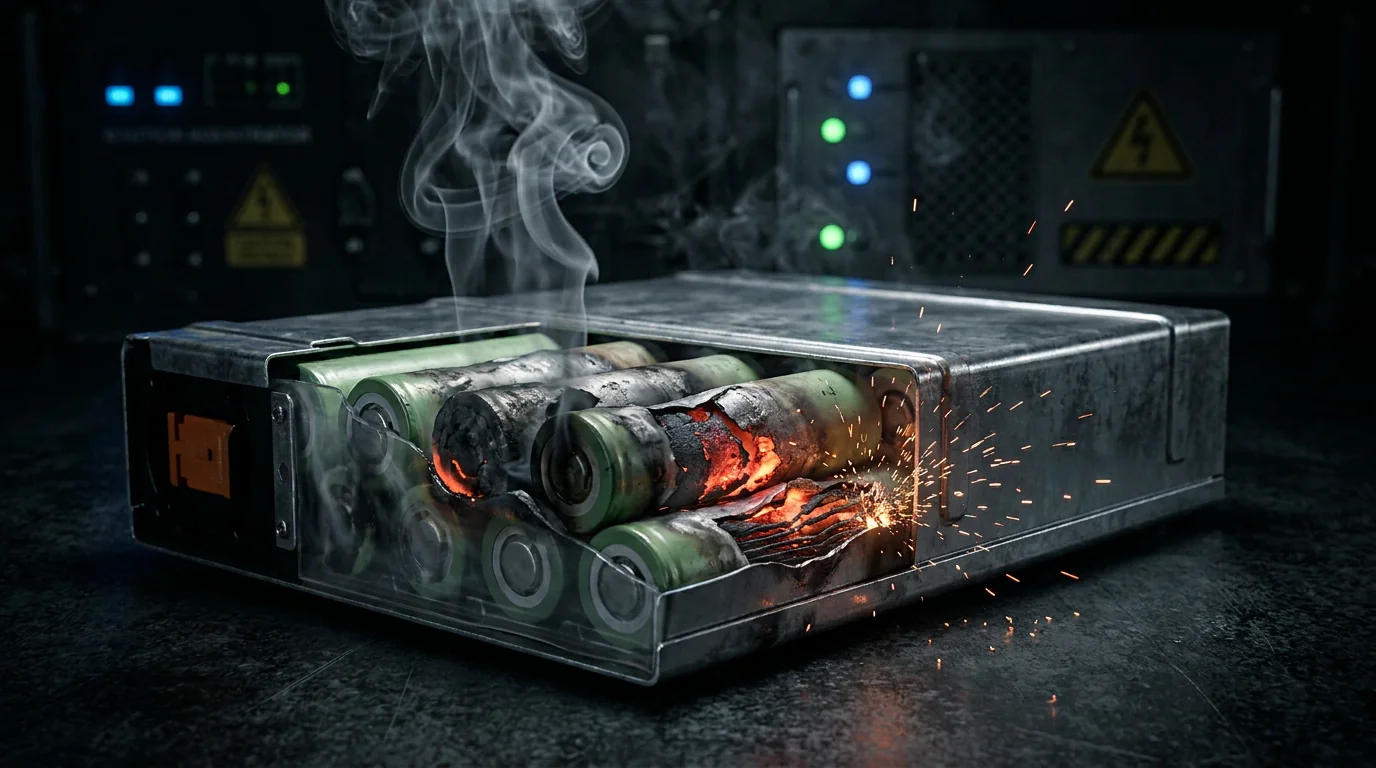
Thermal runaway resurfaces in conversation every time an EV catches fire — most recently with the Volvo EX30, which led to a 40,323-vehicle global recall in 2026.
The problem is that much of what gets shared is wrong, and one piece of it is genuinely dangerous: the belief that you can’t use water on an EV battery fire. That is the opposite of what fire services worldwide actually do. This piece covers the real mechanism and corrects the misconceptions that could lead someone to the wrong decision in the moment that matters.
How thermal runaway works, at cell level
An EV pack contains hundreds to thousands of cells packed tightly into modules. The mechanism is a chain reaction:
- Initiation — one cell generates more internal heat than the cooling system can remove (from a cell defect, impact damage, excessive state of charge, or external heat)
- Decomposition reactions — the SEI layer on the anode breaks down, followed by the electrolyte and the cathode. These reactions are exothermic, so they feed themselves
- Gas and pressure — the cell swells and vents, releasing flammable gases and hydrogen fluoride (HF) from the electrolyte
- Propagation — heat from the first cell pushes its neighbours past their own threshold. This is the step that turns a single-cell event into a vehicle fire
- No atmospheric oxygen required — an NMC cathode releases oxygen as it decomposes, so the reaction can sustain itself. This is why smothering does not stop it
On toxic gases: HF comes primarily from the battery electrolyte. Hydrogen cyanide (HCN) comes mainly from burning interior trim and plastics — which happens in petrol car fires too. It is not a primary product of the cells.
The five main causes
1. Cell manufacturing defects (the Volvo EX30 case)
The EX30 recall documentation identifies a cell manufacturing defect that can allow cells to overheat at a high state of charge. That is why the interim measure was to cap charging at 70% and park away from buildings.
The important point: an owner cannot inspect for this. All you can do is check whether your VIN is in scope and follow the manufacturer’s instructions exactly.
2. High state of charge and repeated hard charging
- Sitting near full for extended periods (for NMC/NCA chemistries)
- Multiple DC fast charges in a single day, especially at Phuket’s ambient temperatures
- Charging a very cold pack without preconditioning risks lithium plating, which accumulates and can eventually pierce the separator
3. Physical damage
- Hard underbody impacts — kerbs, high rocks, speed bumps taken badly
- Damage may show no symptoms at first, with runaway occurring days or weeks later
- After a collision or a significant underbody strike, have the pack inspected before continuing to use the car, even if it drives normally
4. External heat
- Fire from an adjacent vehicle or structure
- A malfunctioning pack cooling system (coolant leak, failed pump)
5. Non-compliant charging equipment
- Uncertified chargers or cables
- Poor household earthing or undersized mains cable — a common finding in older Phuket properties
NMC vs LFP: the difference is the onset temperature
| NMC / NCA | LFP | |
|---|---|---|
| Thermal runaway onset | roughly 150-200°C | roughly 250-300°C |
| Releases oxygen when decomposing | Yes — can sustain its own fire | Far less |
| Energy density | Higher — more range per kg | Lower — heavier for the same range |
| Routine charging to 100% | Not advised | Fine, and periodically recommended for calibration |
| Found in | Long-range Teslas, Volvo EX30 (69 kWh), many premium models | BYD Blade, MG, NETA, Standard Range Teslas |
LFP is not fireproof — it just takes far more severe conditions to ignite, and it propagates more slowly once it does. BYD’s Blade Battery combines LFP chemistry with a cell-to-pack structure and passed a nail penetration test without igniting, which became a benchmark the industry now references frequently.
For Phuket specifically: if you have the choice and don’t need maximum range, LFP tolerates sustained heat better in an island climate.
⚠️ Correcting the firefighting myths
This is where misinformation is most widespread, and where being wrong is most dangerous:
| What you often hear | What fire services actually do |
|---|---|
| ”Water doesn’t work, lithium reacts with water” | Water is the recommended primary agent. Automotive lithium-ion cells do not contain free lithium metal that reacts violently with water |
| ”You need special chemicals” | Do not use CO₂, dry powder or foam — none of them can remove heat from the cells |
| ”Once it’s out, it’s over” | It can reignite hours or days later. This is the real hazard — an extinguished vehicle must be quarantined in the open and monitored |
| ”One extinguisher’s worth of water is enough” | Documented incidents used 3,000 to over 20,000 US gallons (roughly 11,000-76,000 litres) on a single vehicle |
The correct principle: water does not “extinguish” the chemistry inside a cell — it cools the pack to stop propagation into the next cell. That is why it takes enormous, sustained volumes. In Fire Protection Research Foundation testing, a pack of roughly 600 lb required more than 2,600 gallons (~9,800 litres).
Are EV fire blankets worth buying?
They are useful, but not in the role most people assume. A ceramic-fibre blanket rated to around 1,400-1,500°C is used to limit spread to adjacent vehicles and property and to cut radiant heat. It does not stop the reaction inside the pack, because that reaction doesn’t need atmospheric oxygen.
If you buy one, understand that you’re buying containment, not extinguishment.
What an owner should actually do
- Stop in the open, away from buildings, other vehicles and anything flammable
- Get everyone out immediately. Do not go back for belongings
- Move at least 15 metres away and stay upwind
- Call 199 and state clearly that it is an electric vehicle with a suspected high-voltage battery event — that changes how the crew prepares and how much water they bring
- Do not open the bonnet or any panels. Adding air doesn’t help, and it exposes you to toxic gas and flame jetting
- Do not attempt it with a handheld extinguisher. There is nowhere near enough agent to remove heat from a pack
Warning signs before that point: a high-voltage battery temperature warning on the display; a sharp sweet chemical or burning smell; popping or hissing from underneath; light smoke. If you notice any of these, pull over in the open and get out. Do not keep driving to “make it home.”
The standards are changing, and Thailand is on an older edition
| Standard | What it requires | Status |
|---|---|---|
| UN R100 Rev.2 | Passive safety — crash, vibration, external fire, water immersion and overcharge testing | In force in Thailand since 2023 (alongside UN R136 for electric motorcycles) |
| UN R100-05 | Adds a requirement to warn occupants within 5 minutes of a thermal event | Europe: new vehicle types September 2027, all new types September 2029 |
| GB 38031-2025 (China) | No fire and no explosion for 120 minutes after a cell is deliberately driven into thermal runaway, plus a warning within 5 minutes and no visible smoke entering the cabin | Effective July 2026 |
The meaningful difference: the standard Thailand applies tests whether the battery survives an external accident without igniting. GB 38031-2025 tests whether a pack can contain a cell that has already gone into thermal runaway — which is much closer to how real incidents begin.
This matters directly to Thai buyers, since most EVs here are imported from or assembled to Chinese specifications. Vehicles built to the newer requirement face a considerably stricter propagation bar than earlier batches.
Practical guidance for EV owners in Phuket
Charging
- NMC: use 20-80% day to day. Charge to 100% only before a long trip, and set off rather than leaving it sitting full
- LFP: 100% is fine and periodically desirable so the BMS can recalibrate its SOC estimate
- Cap DC fast charging at two sessions a day — heat accumulates faster here than people expect
- Only use certified chargers and cables, and have an electrician verify earthing and mains cable size before installation
- If your car is subject to a recall, follow the manufacturer’s restriction exactly. It is not negotiable
Parking
- Park in shade. Under-bonnet temperatures in Phuket reach 50-60°C at midday
- Avoid overnight charging in a garage beneath the house if the car is recall-affected or has a history of underbody impact
- For long parking, leave the pack at roughly 50-60% — neither full nor nearly empty
Maintenance
- Accept OTA and firmware updates. These frequently adjust BMS logic that is directly safety-related
- Have the pack inspected after flood wading or an underbody strike before you plug in
- Keep the 12V battery healthy. The high-voltage BMS runs on 12V — if the 12V dies, the monitoring system isn’t watching
- Check recall status by VIN at least once a year
EV Phuket — EV Battery Service Island-Wide
- 12V battery replacement for every EV brand, with system reset
- Free 12V health check — voltage, CCA and load test
- Post-flood inspection before you plug in
- 24-hour emergency jump start (cars only — we don’t service motorcycles)
Call 098-168-9907 — 20-30 minute arrival anywhere in Phuket
Related Reading
- Volvo EX30 Fire Case Study - the recall in detail
- EV Batteries in Heat and Humidity - the Phuket baseline
- BYD’s 115,000-Car Recall - what it actually was
- EV Care in Phuket’s Rainy Season - water ingress and IP ratings
Sources: NFPA (Best Practices for Emergency Response to Incidents Involving Electric Vehicle Battery Hazards), Fire Protection Research Foundation, US Fire Administration, UNECE Regulation No. 100, GB 38031-2025, Thailand Automotive Institute (EV battery test centre), Volvo Cars recall filings — verified July 2026.