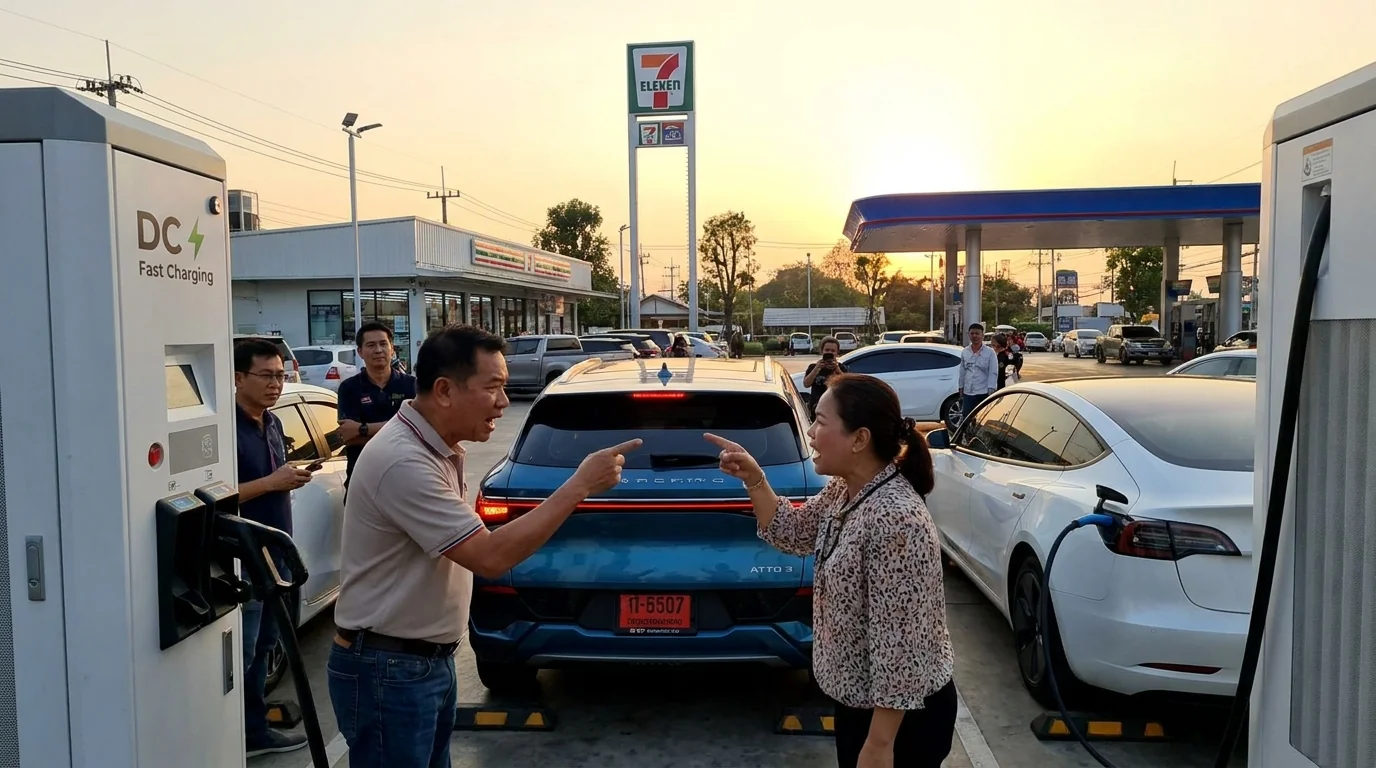
The story everyone tells is “there aren’t enough chargers.” The actual numbers say something else.
From the Electric Vehicle Association of Thailand (EVAT):
| Dec 2024 | Apr 2026 | Change | |
|---|---|---|---|
| DC connectors | 5,782 | 9,049 | +56% |
| AC connectors | 5,685 | 5,437 | -4% |
| Total connectors | 11,467 | 14,486 | +26% |
| Charging locations | — | 4,817 | — |
DC connectors grew by more than half in under a year and a half. So why are there still queues?
Because the problem isn’t the total — it’s concentration. And that’s a different problem requiring a different fix.
Demand concentrates in three dimensions
1. Concentration in time
9,049 DC connectors nationwide sounds ample, right up until it’s Friday evening before a long weekend. Everyone travels at once, to the same stations, in the same window. An annual average tells you nothing about the experience users actually have.
Petrol cars don’t have this problem because refuelling takes five minutes. An EV occupies a connector for 20-60 minutes — one petrol pump serves roughly ten times as many vehicles as one DC connector in the same period. That arithmetic produces queues even when connector counts look sufficient.
2. Concentration in place
Connectors are distributed by population density and major routes. Users concentrate at destinations — large malls, stations on tourist corridors, and accommodation clusters.
This is especially sharp in Phuket, an island with limited main routes and demand that swings with the tourist season rather than tracking the national average. At the same location, high-season demand can be several times low-season demand.
3. Concentration at high-power connectors
Drivers always pick the fastest available point, so high-power DC sits full while AC units beside it go unused. You can read this in the EVAT figures: public AC connectors actually declined over the same period DC grew, because operators are responding to that behaviour.
What actually causes conflict at a charger
From what we see and hear from customers in Phuket, nearly all of it comes down to four things:
1. No clear queueing system Unlike a petrol station with clearly ordered bays, charging areas rarely have any organised queue. Disputes over who arrived first are the single most common flashpoint.
2. Cars left plugged in after charging finishes The biggest source of resentment, and the easiest to fix. Several operators have started charging an idle fee for occupying a connector after the session ends — which works considerably better than asking people nicely.
3. Petrol cars parked in charging bays Common at mall car parks where the charging bays occupy good positions. Thailand has no meaningfully enforced penalty for this, unlike several countries where it’s a fineable offence.
4. Broken units with no status reporting Worse than a queue, because you drive there and find it unusable while the app showed it free. Uptime matters as much as connector count — but it’s a figure almost nobody publishes.
Charging costs in Thailand (indicative ranges)
| Type | Average per kWh | 10-80% |
|---|---|---|
| Home AC (overnight TOU tariff) | ฿4-5 | 6-10 hours |
| Public AC (7-11 kW) | ฿6-8 | 3-5 hours |
| DC (50 kW) | ฿7-9 | 45-60 minutes |
| High-power DC (150 kW+) | ฿8-12 | 18-30 minutes |
| DC at peak | ฿10-15 | — |
The gap between home charging and peak DC is roughly 3×, which is why a home charger pays for itself within one to two years for anyone driving regularly.
Example: 1,000 km a month
- Mostly home charging: about ฿800-1,200
- Mostly DC: about ฿1,600-2,400
- A petrol car at 12 km/litre: about ฿2,500-3,000
Strategy for EV owners in Phuket
1. Home charging is the real answer
If you have a fixed parking space, this genuinely solves the problem — queues, cost and long-term battery health all at once. Installation starts around ฿15,000-30,000 and pays back in one to two years.
2. Avoid the windows when everyone else goes
- Avoid: Friday evenings, the day before long weekends, and the post-work evening peak
- Quiet: weekday middays from 10:00-15:00, and after 22:00 — which often carries a cheaper TOU rate as well
3. 80% is enough
Going from 80% to 100% takes almost as long as 10% to 80%, because the car reduces charging power to protect the pack. Charging to 100% at a DC point wastes your own time, lengthens the queue and isn’t good for the battery either.
4. Install every network’s app in advance
Thailand’s major networks each have their own app. Register and add a payment method before you set off, not while standing at the unit — and always have at least one backup location in mind in case the first is out of service.
5. Don’t use DC for a small top-up
Arriving with more than 60-70% and plugging into DC takes a resource someone else needs more, and you’ll get poor speed anyway since charging slows sharply at high state of charge.
On charging etiquette
We’ve covered this separately, since there’s enough detail to warrant it — see Public Charging Etiquette.
The shortest possible summary: move your car the moment charging finishes. That one habit fixes more than all the others combined.
EV Phuket — EV Battery Service Island-Wide
- 12V battery replacement for every EV brand, with system reset
- Free 12V health check — voltage, CCA and load test
- 24-hour emergency jump start (cars only — we don’t service motorcycles)
- 20-30 minute arrival anywhere in Phuket
Call 098-168-9907
Related Reading
- Public Charging Etiquette - the unwritten rules
- Home Wall Charger Installation - choosing and fitting one
- Used EV Values - what depreciation looks like
- EV Batteries in Heat and Humidity - why fast charging costs more here
Sources: Electric Vehicle Association of Thailand (EVAT) charging infrastructure statistics for December 2024 and April 2026, published tariffs from Thai charging network operators, EV Phuket service records — verified July 2026.