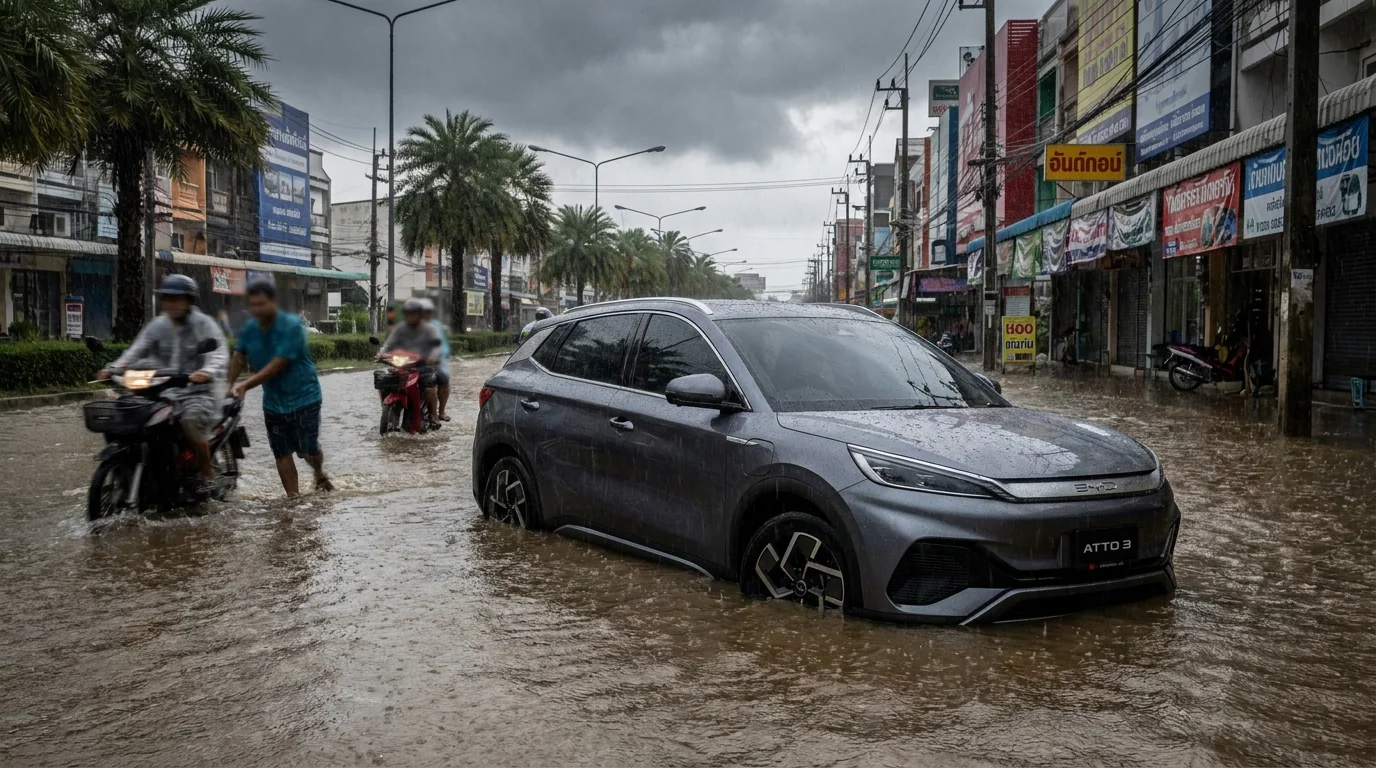
Phuket’s monsoon runs from April to November, with reliable flooding at Patong, Chalong and Kathu. The question we’re asked most in that window is “can an EV drive through water?”
The short answer: IP67 is not a licence to wade — and the best evidence for that comes from a manufacturer’s own filing.
The key evidence: BYD recalled 71,248 cars over exactly this
On 17 October 2025, BYD recalled 71,248 BYD Yuan Pro vehicles in China — a model never sold in Thailand. The recall documentation states the cause plainly:
Battery gaskets on some vehicles were improperly installed. During “prolonged high-speed driving through water,” water can enter the battery pack, degrading insulation and reducing drive power.
This is unusually valuable: a manufacturer confirming, across 71,248 vehicles, that a pack which met its water-ingress specification can still take on water if one seal is imperfectly assembled and the usage conditions are severe enough.
The lesson for owners of any brand: a stated ingress-protection rating is a result obtained from a new, correctly-assembled vehicle under standardised test conditions. It is not a guarantee about your three-year-old car in fast-moving water.
What IP67 actually tests
| Digit | Meaning |
|---|---|
| IP | Ingress Protection, per IEC 60529 |
| 6 (first digit) | Fully dust-tight |
| 7 (second digit) | Withstands immersion in still water to 1 metre for 30 minutes |
| 8 | Withstands immersion deeper than 1 metre, under conditions the manufacturer specifies |
Most EVs quote IP67 for the high-voltage pack; some quote IP68.
The four things that number does not tell you
1. It tests still water, not moving water Immersion in a tank is nothing like driving through a flowing flood. Motion creates dynamic pressure at the front of the car far above the static pressure at the same depth, and the bow wave can rise tens of centimetres above the actual water level. That is precisely the “prolonged high-speed driving through water” condition BYD’s filing describes.
2. It tests new cars, not seals that have been in service Rubber seals degrade with age, heat and UV — Phuket accelerates all three. An underbody impact can also deform a seal with no externally visible sign.
3. It covers the high-voltage pack only Everything else has a far lower rating: motors, inverters, control modules, wiring, the charge port, and the 12V battery. In Phuket we see more cases of an intact main pack in a car that won’t run because the 12V system and control modules are damaged than of a failed traction pack.
4. It is not designed for prolonged immersion IP67 means 30 minutes. A car sitting submerged overnight in a flooded car park is well beyond the test’s scope.
The damage we actually see, in order of frequency
1. 12V battery and low-voltage electrics (most common)
Water reaches the front compartment or cabin and damages the 12V battery, connectors and control modules. The symptom is a car that won’t wake at all, while the main pack is perfectly fine. Repairs run from thousands to tens of thousands of baht.
2. Insulation resistance drops
Water or moisture degrades the high-voltage system’s insulation. The car detects this and cuts propulsion or enters a limited mode as a safety measure — the same mechanism described in BYD’s filing.
3. Gradual corrosion
Especially with seawater or brackish water, a genuine risk on Phuket’s coast. Salt accelerates corrosion at connectors and joints. This kind of damage shows no immediate symptoms and surfaces months later — by which point an insurance claim is much harder to establish.
4. Water reaching cell level (least common, most serious)
If water genuinely reaches the cells it can create unwanted internal current paths and lead to thermal runaway, potentially hours or days after the event. This is why a submerged vehicle must be quarantined in the open and monitored — not parked in a garage.
What a high-voltage pack actually costs
Most manufacturers publish no official out-of-warranty pack price in many markets. What exists is documented cases and figures from other markets:
| Source | Figure |
|---|---|
| Documented Thai case (BYD Atto 3, accident damage) | ~฿900,000 |
| Australia, out-of-warranty replacement including labour | A$18,000-26,000 (roughly ฿410,000-590,000) |
| Malaysia, estimated | RM30,000-50,000 (roughly ฿230,000-390,000) |
What these tell you is not an exact price but the order of magnitude of the risk — a pack replacement is comparable to a meaningful share of the car’s value, and in Thailand import duty and parts lead times add to it.
Ask your brand’s service centre directly before making decisions about insurance cover. Don’t set your sum insured from an internet figure.
EV insurance and flooding: getting it right
There’s a widespread belief that “if you drive into the water yourself, insurance won’t pay.” That does not match the standard policy.
Class-1 motor insurance in Thailand covers flood damage, including damage to electrical systems, subject to the terms written into the policy. This is standard class-1 cover.
The four questions that actually matter:
- Does your sum insured cover a pack replacement? If it’s lower than the pack cost, you pay the difference. This is the single biggest gap for EV owners
- What is your deductible, and are there special terms for water damage?
- Is the policy an EV-specific one? Several Thai insurers now offer class-1 policies written specifically for electric vehicles, with clearer terms around the high-voltage battery than a general policy has
- Age-related degradation is not accident damage. If capacity has faded through use, that is a matter for the manufacturer’s warranty, not insurance
A timing warning: corrosion damage that appears six months later is very hard to tie back to the flood event. Report the incident and document it immediately, even if the car appears fine.
Practical guidance for EV owners in Phuket
During monsoon (April-November)
- Avoid the known flood points — Patong, Chalong, Kathu and the underpasses. Check conditions before you set out
- Don’t park low — basement car parks, under bridges, low-lying ground — when heavy rain is forecast
- If you genuinely cannot avoid it, don’t enter water above the visible wheel rim, drive slowly and steadily so you don’t create a bow wave, and never stop in the water
- Never enter water where you can’t see the road surface — a missing manhole cover is a bigger risk than the water itself
After driving through water — in this order
- Do not plug in to charge until the car has been checked. This is the most important item. Energising a system whose insulation may be compromised adds risk
- Read every warning message on the display, particularly anything about the high-voltage system or propulsion
- Listen for anything unusual, especially cooling fans running hard after shutdown
- Have insulation resistance and the 12V battery checked before continuing to use the car
- Photograph everything with timestamps in case insurance becomes relevant later
If the car has been submerged
- Don’t try to start or wake it
- Don’t open panels or touch orange cabling — orange means high voltage
- Call a recovery service that knows EV procedure, and say it’s electric when you call
- Store it in the open, away from buildings and other vehicles — ignition can occur hours to days later
- Notify your insurer immediately, with photographs and any record of water depth
EV Phuket — Post-Flood EV Inspection
- Low-voltage electrics and 12V battery check
- BMS communication check with the high-voltage pack
- Insulation resistance measurement on the high-voltage system
- 12V battery replacement where water damage has occurred
- Help assembling photographs and documentation for an insurance claim
- 24-hour emergency service, 20-30 minute arrival anywhere in Phuket (jump starts for cars only — we don’t service motorcycles)
Call 098-168-9907
Related Reading
- EV Care in Phuket’s Rainy Season - the full wet-season routine
- BYD’s 115,000-Car Recall - including the Yuan Pro water-ingress campaign
- Thermal Runaway Explained - why delayed ignition happens
- EV Battery Service
Sources: IEC 60529 (IP ratings), BYD recall filing to SAMR (17 October 2025), Thai class-1 motor insurance policy documentation, reported pack replacement cases in Thailand, Australia and Malaysia, EV Phuket service records — verified July 2026.