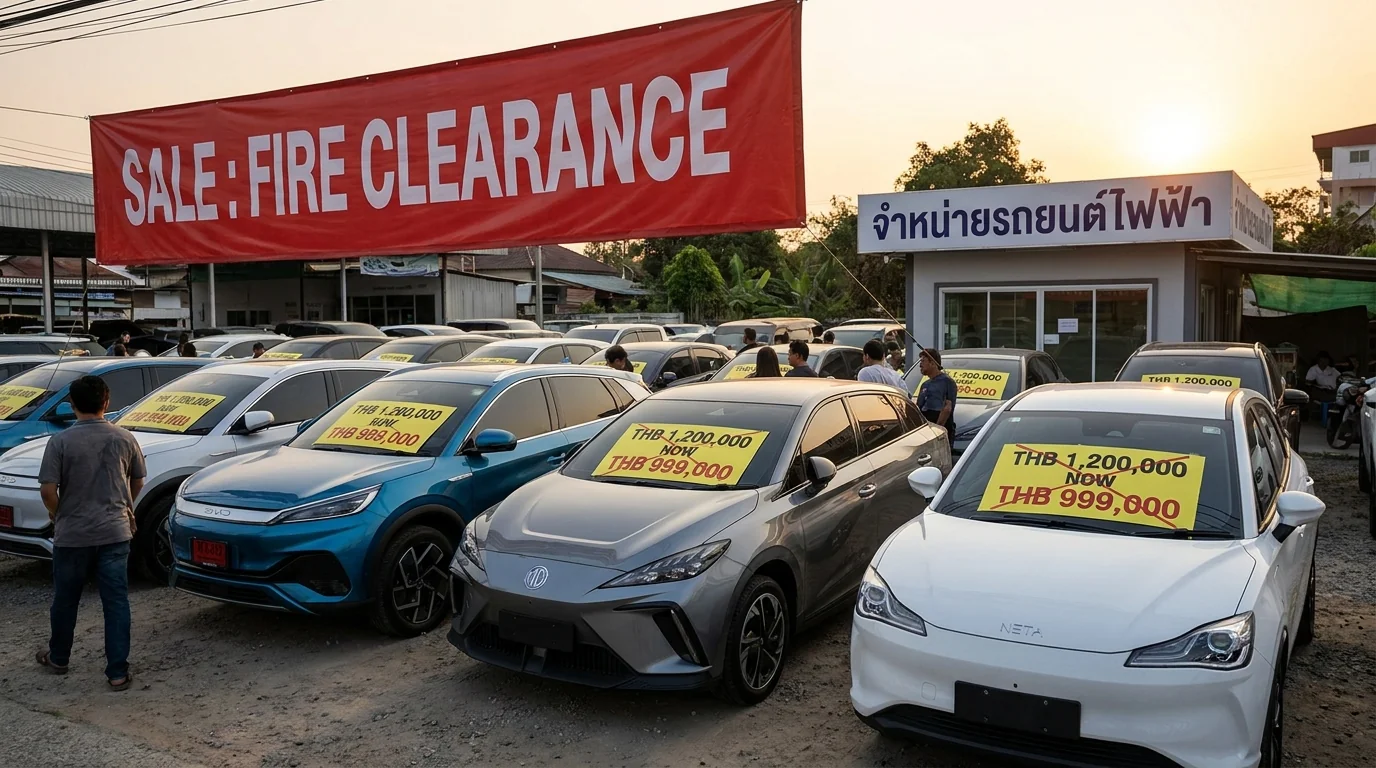
The most interesting thing about Thailand’s EV price war isn’t how far prices fell. It’s that price stopped functioning as a stable reference at all.
The same model can go up and then come back down within months, and six-figure campaign discounts have become routine. When that’s the environment, both how you buy and how you value your own car have to change.
The clearest case study: BYD Atto 3
| Period | Price | What happened |
|---|---|---|
| Around 2023 | ฿1,190,000 (Extended) | Launch price, imported from China |
| 2024-2025 | Progressive reductions | Local assembly begins, competition intensifies |
| Early 2026 | ฿849,900 (Extended) | Increased by ฿150,000 over the previous price |
| Motor Show 2026 | ฿769,900 (Extended) | ฿80,000 off list |
| Motor Show 2026 | ฿669,900 (Premium) | ฿130,000 off ฿799,900 |
| Current | ฿699,900 (Standard Range) | New entry variant added to the range |
Note what happened between early 2026 and the Motor Show: the manufacturer raised the list price, then discounted back down. The result is that list price and transaction price became two different numbers.
Current Thai market pricing (2026)
| Model | Price |
|---|---|
| NETA V II | ฿429,000-459,000 |
| MG4 | ฿559,000 |
| ORA Good Cat | ฿599,000 |
| MG ZS EV | ฿599,000 |
| BYD Atto 3 | ฿699,900 (Standard) · ฿769,900-849,900 (Extended) |
| Tesla Model 3 | ฿1,599,000 |
| Tesla Model Y | ฿1,749,000 |
Entry-level EVs in Thailand now sit in the same price band as petrol eco-cars — something that had never happened before.
Why prices swing like this
1. Production moved to Thailand Imported cars carried duty and shipping. Local assembly changes the entire cost structure, so prices can genuinely fall without the seller losing money.
2. The conditions attached to state incentives Thailand’s EV support measures are tied to local production obligations within defined timeframes. That gives manufacturers stronger reasons to push volume in some periods than others — which shows up as bursts of aggressive campaigning.
3. Chinese overcapacity EV production capacity in China exceeds domestic demand, making export markets like Thailand an important outlet.
4. Extremely crowded price bands With many models from many brands sitting between ฿550,000 and ฿800,000 simultaneously, price becomes the primary competitive lever.
What it means for three groups
Existing owners
Anyone who bought at launch pricing absorbed the full hit, and it isn’t recoverable however well the car has been looked after — because used values are set by new-car prices, not by condition. That’s covered in detail in Why Used EV Values Collapsed.
Buyers
Clearly advantaged, but the approach has to change:
- Don’t negotiate from list price. Always ask what campaign is running. Discounts of ฿80,000-130,000 are real figures
- Timing matters a lot. Motor show periods and quarter-ends tend to carry stronger campaigns
- Compare total value, not just the discount. Insurance, a home charger, warranty length and whether the cover transfers all have monetary value
- Price in depreciation up front. If prices are still trending down, buying expensive to sell in three years is a costly plan
Short-term flippers
This plan does not work in this market. Depreciation over the first two to three years is accelerated by new-car price cuts. The people who come out ahead are those holding five years or more, or buying used after the large depreciation hit has already been taken.
What the lower price doesn’t include
Falling prices are good for consumers, but some costs haven’t moved with them:
- The 12V battery — around 18-24 months in Phuket, at ฿2,500-6,500 a time, covered by no warranty
- The service network — a brand competing hard on price without the balance sheet to support it is a long-term risk. NETA is the clearest lesson here. A low price is worth nothing if there’s nobody to repair the car in three years
- Depreciation itself — which in many cases exceeds electricity and maintenance combined
So the question to ask before buying isn’t “how much off?” but “will this brand still have service centres and parts in five to eight years?”
EV Phuket — EV Battery Service Island-Wide
- 12V battery replacement for every EV brand, with system reset
- Free 12V health check — voltage, CCA and load test
- Pre-purchase used EV inspection with a vehicle health certificate, ฿1,500-3,000
- 24-hour emergency jump start (cars only — we don’t service motorcycles)
- 20-30 minute arrival anywhere in Phuket
Call 098-168-9907
Related Reading
- Why Used EV Values Collapsed - the depreciation mechanics
- The NETA Collapse - what price competition without a balance sheet leads to
- EV Battery Warranties - transferable cover has real value
- Used EV Buying Checklist - the full inspection walkthrough
Sources: Official 2026 Thai distributor pricing (BYD, MG, ORA, Tesla, NETA), price adjustment and Motor Show 2026 campaign announcements, 2023 launch prices, AutoLife Thailand — verified July 2026.