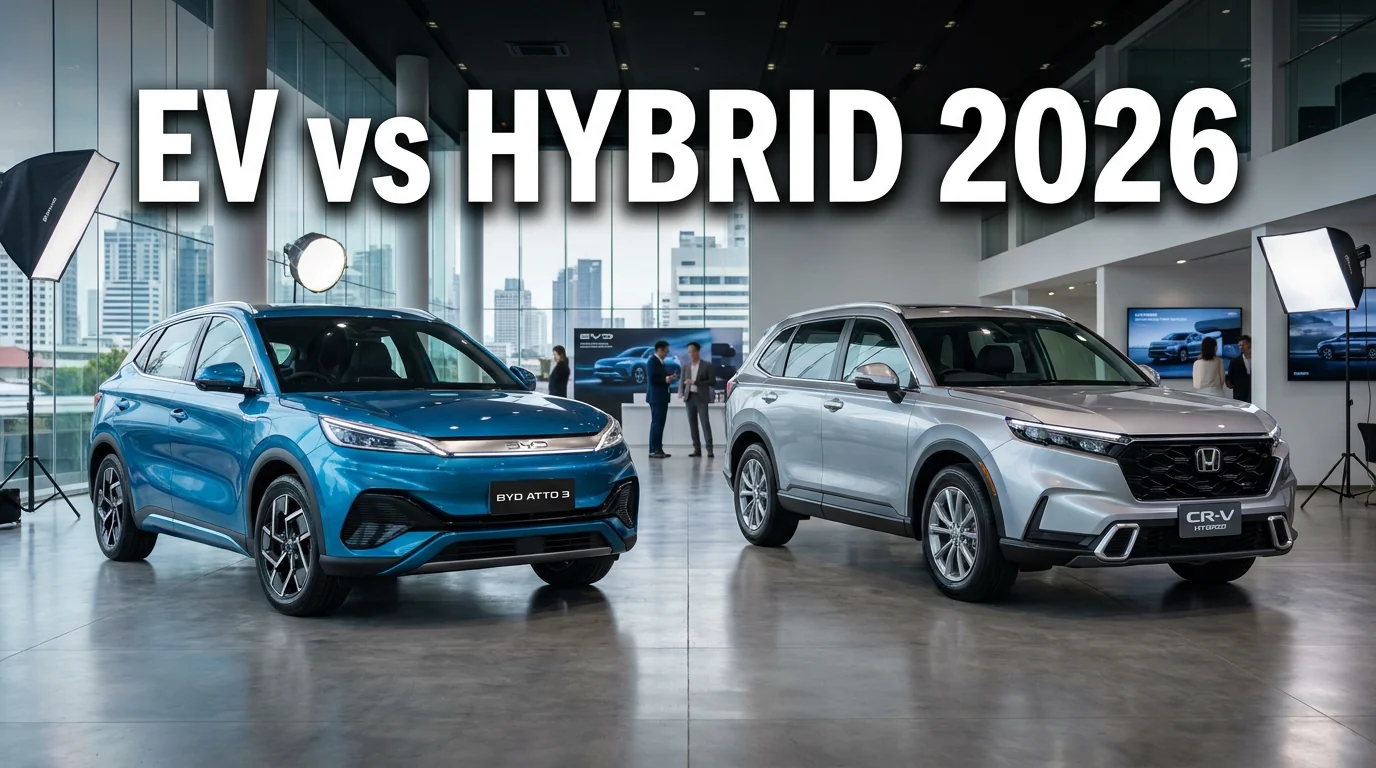
Thai buyers in 2026 keep arriving at the same fork in the road: full EV or hybrid? We’ll answer it with two cars in the same segment — the BYD Atto 3 Extended at ฿949,900 and the Honda CR-V e:HEV at ฿1,409,900 — and real five-year numbers.
The short version: the EV is ฿707,000 cheaper over five years. Whether that makes it the right car for you is a separate question, and it depends almost entirely on where you drive.
The Three Types, Briefly
BEV (battery electric) — battery only, must be plugged in, no engine, zero tailpipe emissions.
HEV (hybrid) — petrol engine plus electric motors, self-charging, never plugged in, runs primarily on fuel, roughly 30-40% lower emissions than a conventional petrol car.
PHEV (plug-in hybrid) — like an HEV but chargeable, typically 50-100 km on electricity alone, with the engine as backup.
BYD Atto 3 (BEV) vs Honda CR-V e:HEV (HEV)
| Item | BYD Atto 3 Extended (BEV) | Honda CR-V e:HEV (HEV) |
|---|---|---|
| Price (May 2026) | ฿949,900 | ฿1,409,900 |
| Type | Full EV | Hybrid |
| Engine | None | 2.0L i-VTEC + twin motors |
| Battery | 60 kWh (Blade LFP) | 1.06 kWh (NiMH) |
| Range | 480 km per charge | 900-1,100 km per tank |
| Peak power | 204 hp | 184 hp (combined) |
| 0-100 km/h | 7.3 s | 8.8 s |
| Consumption | 19 kWh/100 km | 5.0 L/100 km |
| Cost per 100 km | ฿95 (at ฿5/kWh) | ฿175 (at ฿35/L) |
| Drivetrain | FWD | FWD/AWD |
| EV3.5 subsidy | Yes, ฿50,000 | No |
Five-Year Cost of Ownership
Assuming 20,000 km/year — 100,000 km over five years:
| Item | BYD Atto 3 (BEV) | Honda CR-V e:HEV |
|---|---|---|
| List price | ฿949,900 | ฿1,409,900 |
| EV3.5 subsidy | -฿50,000 | — |
| Net purchase price | ฿899,900 | ฿1,409,900 |
| Financed over 5 years (3.5%) | ฿1,017,000 | ฿1,594,000 |
| Electricity, 100,000 km | ฿95,000 | — |
| Fuel, 100,000 km | — | ฿175,000 |
| Servicing | ฿15,000 | ฿35,000 |
| Engine oil changes | — | ฿8,000 |
| Comprehensive insurance | ฿85,000 | ฿110,000 |
| 12V battery (every ~3 years) | ฿7,000 | ฿4,000 |
| Five-year total | ฿1,219,000 | ฿1,926,000 |
| Difference | — | +฿707,000 |
Two thirds of that gap is simply the purchase price. The rest is fuel: ฿175 per 100 km versus ฿95 adds up to ฿80,000 over 100,000 km.
Honest Pros and Cons
BEV — BYD Atto 3
Advantages: running cost of roughly ฿0.95/km against ฿1.75/km; no engine servicing at all — no oil, filters, or exhaust work; instant torque; genuinely quiet; ฿50,000 EV3.5 subsidy; and no engine means no engine repair bills, ever.
Disadvantages: you have to plug it in, which means both time and somewhere to do it; 480 km of range; charger coverage outside major provinces is still patchy; a high-voltage pack replacement out of warranty is a serious number (฿800,000+), even if it’s very rare; and depreciation is steeper at roughly 40-50% over five years.
HEV — Honda CR-V e:HEV
Advantages: never needs plugging in; 900-1,100 km per tank; refuelling takes five minutes at any station; Honda’s hybrid technology has 20+ years behind it; better residuals at roughly 30-35% depreciation over five years; and it’s the more relaxing choice if you regularly drive long distances.
Disadvantages: roughly double the running cost per kilometre; ฿460,000 more expensive to buy; conventional engine servicing intervals apply; no EV3.5 subsidy; higher emissions than a BEV.
Who Should Buy Which
Choose a BEV if: you mostly drive in town (50-150 km/day); you can install a wall charger at home; you rarely travel between provinces; long-term running cost matters to you; and you’re comfortable with newer technology.
Choose an HEV if: you frequently drive 300+ km in a trip; you have nowhere to install a charger; you spend time in provinces with sparse charging; you value the five-minute refuel; or you care about resale value more than running cost.
Choose a PHEV if: you want both — short daily trips on electricity, occasional long trips on petrol — and you accept a higher purchase price and more complex maintenance.
What Actually Makes Sense in Phuket
Some context that changes the maths:
- Phuket is 543 km²
- Patong to Phuket Town: 12 km
- Patong to Promthep Cape: 25 km
- Most residents drive 30-80 km a day
- Around 200+ charging points on the island and growing
At 30-80 km a day, a 480 km EV needs charging roughly once a week. Range anxiety is essentially a non-issue here — which is why the cost argument wins so decisively for island driving.
Driving only in Phuket (about 95% of users) → BEV. Atto 3, MG ZS EV, Geely EX2 all work.
Regular trips to Phang Nga or Krabi → HEV. The convenience genuinely matters once you’re off the island.
Renting cars to tourists → HEV. Tourists won’t manage charging, and a returned car with 8% battery is your problem.
Hotel VIP transfers → premium BEV (Tesla Model Y L, BYD Sealion 7) for the silence and the image.
Our Scoring — For a Phuket Owner
| Dimension | BYD Atto 3 (BEV) | Honda CR-V e:HEV |
|---|---|---|
| Cost per km | 10 | 5 |
| Convenience in Phuket | 8 | 9 |
| Range | 6 | 10 |
| Maintenance | 9 | 6 |
| Quietness and refinement | 9 | 7 |
| Resale value | 6 | 8 |
| Long-term reliability confidence | 7 | 9 |
| Environmental impact | 10 | 7 |
| Total | 65/80 | 61/80 |
Verdict for Phuket: BYD Atto 3 (BEV)
The island’s geography does most of the work here. If you lived somewhere with 200 km daily commutes and thin charging, the same table would flip to the Honda.
EV Phuket — We Service Both
Whichever you choose, the 12V battery is what will actually leave you stranded — on a BEV because the car can’t wake up, and on a hybrid because the system won’t boot.
| Type | 12V replacement |
|---|---|
| BEV (BYD, MG, Tesla, Geely and others) | ฿2,500 - ฿6,500 |
| HEV (Honda, Toyota, Nissan) | ฿1,800 - ฿2,800, plus hybrid system check |
Call 098-168-9907 — 24 hours, anywhere in Phuket.
Related Reading
- BYD Atto 3 vs MG ZS EV 2026 - two EVs head to head
- Geely EX2 vs BYD Atto 1 2026 - the budget EV class
- Honda City e:HEV 12V Battery Guide - hybrid 12V explained
- Car Battery Replacement Cost 2026 - full price guide
Sources: BYD Thailand, Honda Thailand, EV Phuket customer service data (2024-2026).