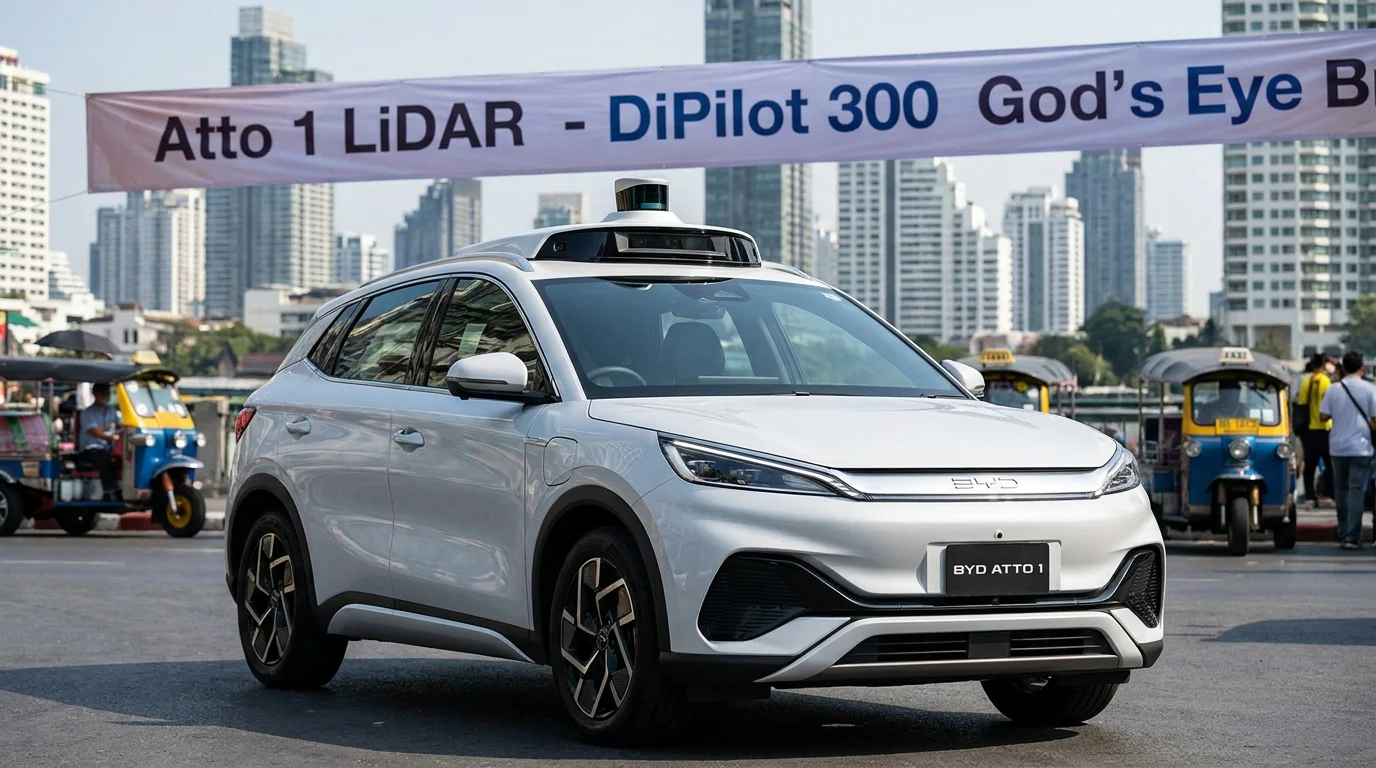
BYD launched the 2026 Atto 1 (minor change) in China — sold there as the Seagull — with DiPilot 300, also called God’s Eye B, the first time a LiDAR-based driver assistance system has appeared on an entry-level electric car.
The system supports City Navigation on Autopilot (CNOA): assisted driving on urban roads, traffic light recognition and roundabout navigation.
The price, stated properly
Most coverage led with the base price. That is not what a LiDAR car costs.
| Configuration | China price | Approx. THB |
|---|---|---|
| Base range (no DiPilot 300) | CNY 69,900-85,900 | ~฿340,000-420,000 |
| With DiPilot 300 (LiDAR) | CNY 90,900-97,900 | ~฿450,000-490,000 |
So the honest version of the headline is: LiDAR-equipped driver assistance now starts around ฿450,000 in China, not ฿300,000. That is still a remarkable figure — BMW and Mercedes both stepped back from LiDAR on cost grounds — but it is roughly 30% above the entry price the number is usually attached to.
These are Chinese-market prices. Thai pricing for any version reflects local taxes, homologation and the EV3.5 subsidy rules, and a China figure is not a preview of a Thai one.
Why LiDAR at this price matters
Camera-only driver assistance struggles in exactly the conditions Phuket supplies constantly: heavy tropical rain, low sun on wet tarmac, and poorly marked roads. LiDAR measures distance directly rather than inferring it from images, which is why it holds up better when visibility degrades.
Whether a system certified for Chinese urban roads behaves the same on a Thai island road with motorcycles filtering, unlit shoulders and unmarked junctions is a separate question — and one no manufacturer has answered yet.
Treat any assisted-driving system as assistance, not autonomy, regardless of the sensor package.
What this signals about where the segment is going
BYD’s advantage here is that it makes its own Blade LFP cells and now its own assisted-driving stack, so it is not paying two sets of supplier margins on the cheapest car in its range. That is what makes ฿450,000 possible at all.
For buyers, the practical implication is a moving target: features that defined premium EVs three years ago are arriving at the bottom of the range faster than cars depreciate. That is one of the reasons used EV values in Thailand have fallen as hard as they have — the cars did not get worse, the new ones got better and cheaper.
→ Why used EVs lose value so fast
Sensors do not change the 12V problem
An Atto 1 with LiDAR still runs a 12V battery that wakes the entire vehicle, and it is excluded from the high-voltage warranty. In Phuket’s heat, roughly 18-24 months and ฿2,500-6,500 to replace.
If anything, more sensors and more always-on modules mean more parasitic drain when the car sits — which is exactly what kills a 12V early. If you leave the car parked for a week or more, turn off remote-connection features in the app first.
→ Caring for your EV’s 12V battery in Phuket · Parking an EV at Phuket airport
EV Phuket — mobile EV battery service
- 12V battery replacement for all BYD models, including system reset
- Free 12V health check — voltage, CCA and load test
- 24-hour emergency jump start (cars only, no motorcycles)
- 20-30 minutes anywhere in Phuket
Call 098-168-9907
→ BYD battery service in Phuket · Choosing and running an EV in Phuket
Sources: Motorist Thailand and CarExpert coverage of the 2026 BYD Atto 1 minor change, carnewschina and Electrek reporting on the 2026 BYD Seagull with LiDAR, Carscoops on LiDAR cost positioning — verified August 2026.