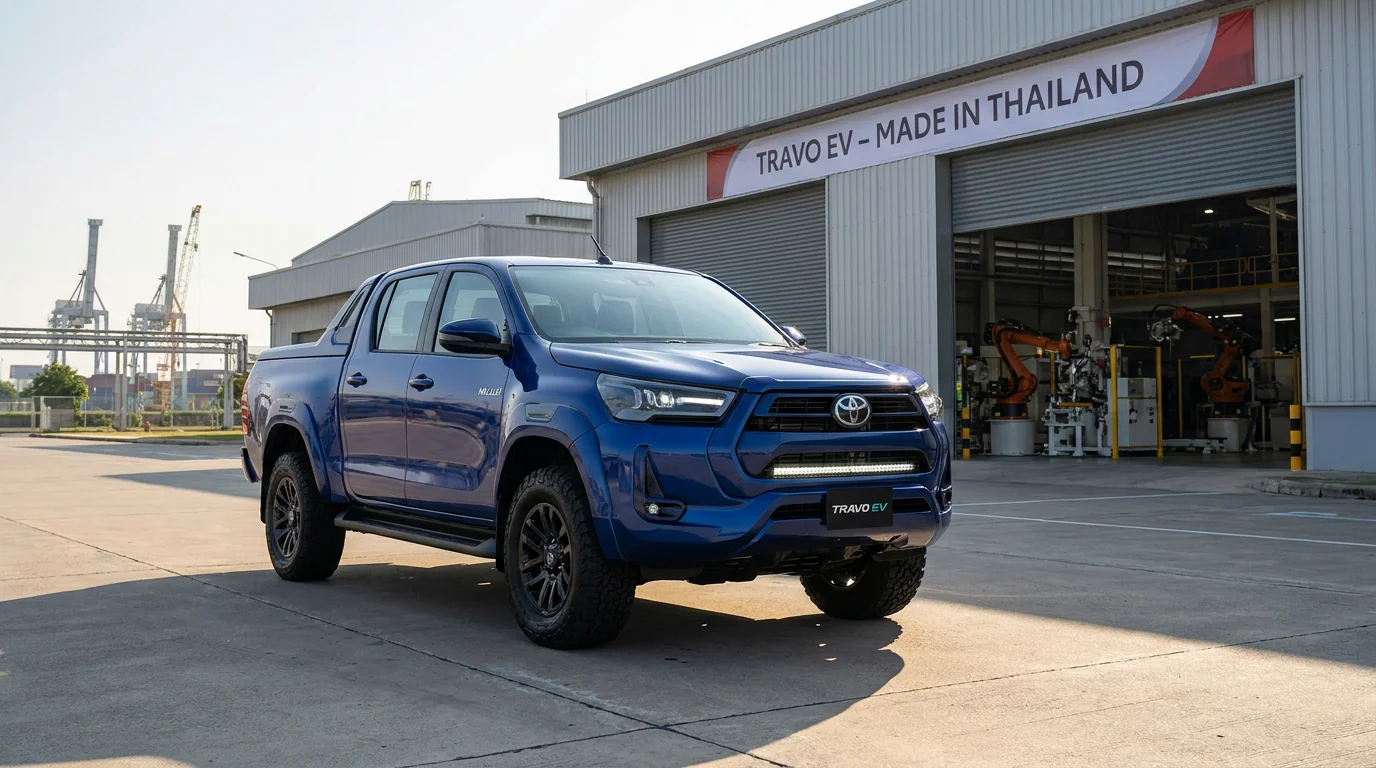
Toyota launched its first electric pickup in Malaysia on 2 April 2026. It is fully imported from Thailand as a CBU, which makes Thailand the production base for Toyota’s electric Hilux across the region.
| Hilux Travo EV | |
|---|---|
| Malaysia price | RM226,300 on-the-road, without insurance |
| Power | 196 PS dual-motor (front 112 PS / 205 Nm, rear 176 PS / 268 Nm) |
| Battery | 59.2 kWh NMC |
| Range | 257 km WLTP |
| Body | Double cab |
| Origin | CBU from Thailand |
It is also the first Toyota in Malaysia supported by the global Toyota Remote app, adding remote locking, a remote immobiliser, geofencing and an SOS emergency call function.
The ninth-generation Hilux — Travo in diesel form and Travo-e as the EV — was unveiled in Thailand, including at Bangkok Motor Show 2026.
The number that decides whether this works: 257 km
For a private buyer in Phuket, 257 km WLTP is genuinely plenty — the island is small and most journeys are short.
For a working pickup, it is the whole question. A pickup is bought to carry loads, tow, and run long days. Every one of those things cuts range hard, and a WLTP figure is measured with none of them happening:
- Load and towing — the single largest range penalty on any EV
- Air conditioning at 35 °C — significant, and constant here
- Rural routes — where DC charging is thinnest
A trade vehicle doing site runs across the island with tools and materials aboard is not going to see 257 km. Anyone considering one for work should map their actual daily distance and where they would charge, before the spec sheet convinces them.
No Thai price yet — and don’t convert the Malaysian one
Malaysian and Thai pricing are not comparable. Excise structures, import duties and — crucially — the EV3.5 subsidy all differ, and RM226,300 reflects Malaysian on-the-road costs.
A Thai-built vehicle sold domestically would also sit under different rules from the same vehicle exported. Any THB figure circulating before an official Thai announcement is an estimate, not a price.
Why Toyota building it here matters
Thailand is the pickup capital of Southeast Asia, and the Hilux is the vehicle the entire category is measured against. Toyota choosing Thailand as the export base for its first electric Hilux commits real manufacturing depth here rather than badge presence.
For owners, that has a practical consequence that newer brands cannot match yet: parts and trained technicians already exist across the country, including in provinces where several Chinese brands have no service presence at all. Over an eight-year ownership window that is worth more than most spec-sheet advantages.
→ When a car brand disappears · Toyota vs BYD pickup comparison
The 12V battery applies to electric pickups too
A working vehicle sits idle for long stretches — weekends, between jobs, over holidays — and that is exactly what kills a 12V battery early. In Phuket’s heat, expect roughly 18-24 months, at ฿2,500-6,500 to replace, covered by no warranty.
→ Caring for your EV’s 12V battery in Phuket
EV Phuket — mobile EV battery service
- 12V battery replacement for all EV brands, including system reset
- Free 12V health check — voltage, CCA and load test
- 24-hour emergency jump start (cars only, no motorcycles)
- 20-30 minutes anywhere in Phuket
Call 098-168-9907
→ Choosing and running an EV in Phuket
Sources: paultan.org Malaysian launch report April 2026, Carlist.my and WapCar ninth-generation Hilux coverage, DriveFast BIMS 2026 Travo and Travo-e report, Thailand EV Board / BOI EV3.5 terms — verified August 2026.